

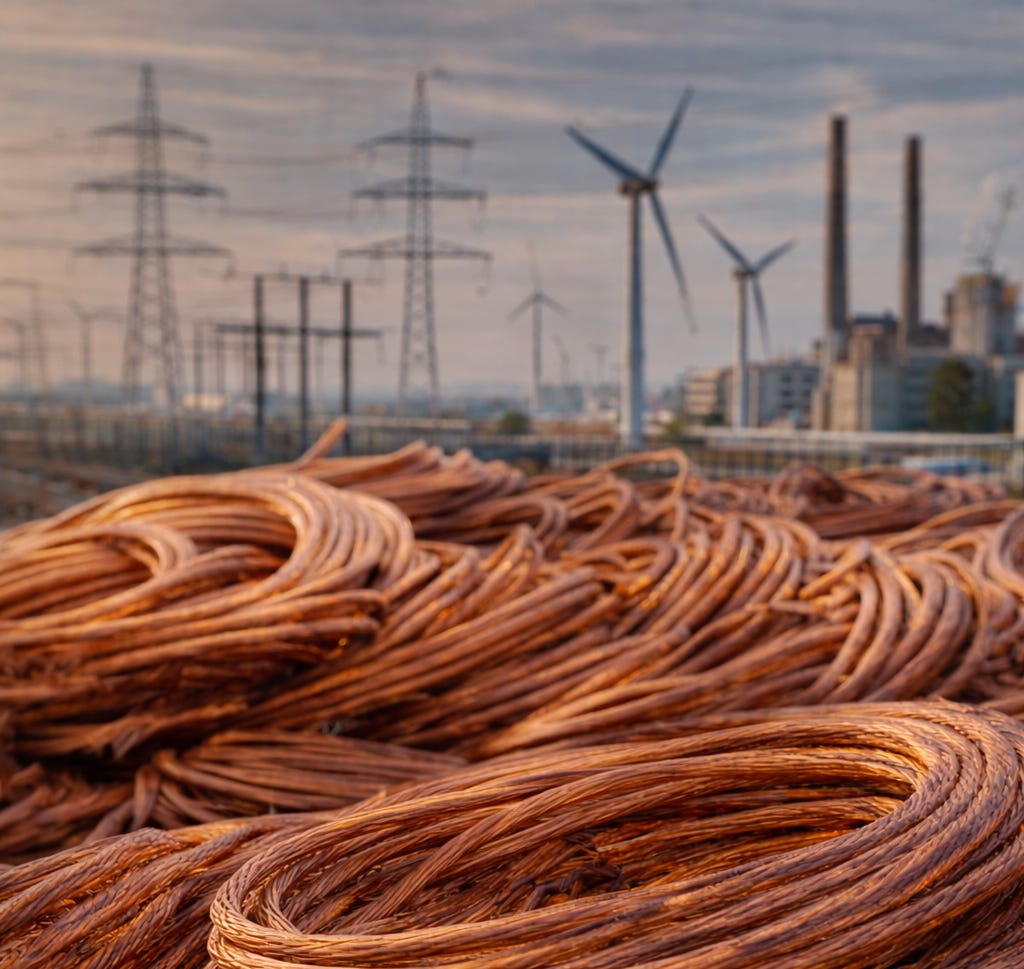
Most discussions about the energy transition focus on ambition — targets, timelines, policy commitments.
They assume that if the will exists, the materials will follow.
Copper breaks that assumption.
One fact alone should reset the conversation:
The amount of copper required to rebuild the global energy system is greater than the amount the world has mined over the past hundred years.
That’s not a pricing issue.
That’s a physical constraint.
Copper Is a Requirement, Not a Signal
Copper is often treated as an economic indicator — a way to “read” growth or slowdown.
That framing misses the point.
Copper doesn’t describe the economy.
It determines what the economy is able to build.
Grids, transmission lines, transformers, EVs, charging infrastructure, renewables, data centers, defense systems — every pathway to electrification runs through copper. There is no scalable substitute and no shortcut around it.
You can finance projects.
You can permit them.
You can announce them.
You cannot execute them without copper.
The Scale Mismatch
The energy transition isn’t incremental. It’s additive.
We are trying to:
maintain existing energy systems
while building parallel electrified ones
while upgrading grids never designed for this load
That stacks copper demand rather than replacing it.
EVs require several times more copper than internal combustion vehicles. Renewable generation and transmission are copper-intensive by design. Add reindustrialization, defense rebuilds, and data center expansion, and the mismatch becomes obvious.
Why Supply Can’t Simply Catch Up
Copper supply doesn’t respond quickly to demand.
New mines take years — often decades — to develop. Ore grades are declining. Permitting is slow. Capital discipline remains tight after past cycles. Production is geographically concentrated.
Copper shortages don’t appear gradually.
They appear late, when plans are already committed and alternatives no longer exist.
Copper Sets the Pace
This isn’t an argument against the energy transition.
It’s an argument for realism.
Copper doesn’t oppose the transition.
It paces it.
Ignoring that doesn’t accelerate outcomes — it produces delays, cost overruns, and fragile systems built under pressure.
Bottom Line
The energy transition isn’t constrained by ideas, capital, or intent.
It’s constrained by materials — and copper sits at the center.
When the amount required exceeds what the world has mined in a century, the question stops being whether the transition happens and becomes how fast it can be executed without breaking the system.
Copper doesn’t care about targets.
It cares about physics, time, and scale.
And those are the hardest constraints of all.
You can read the entire view here