

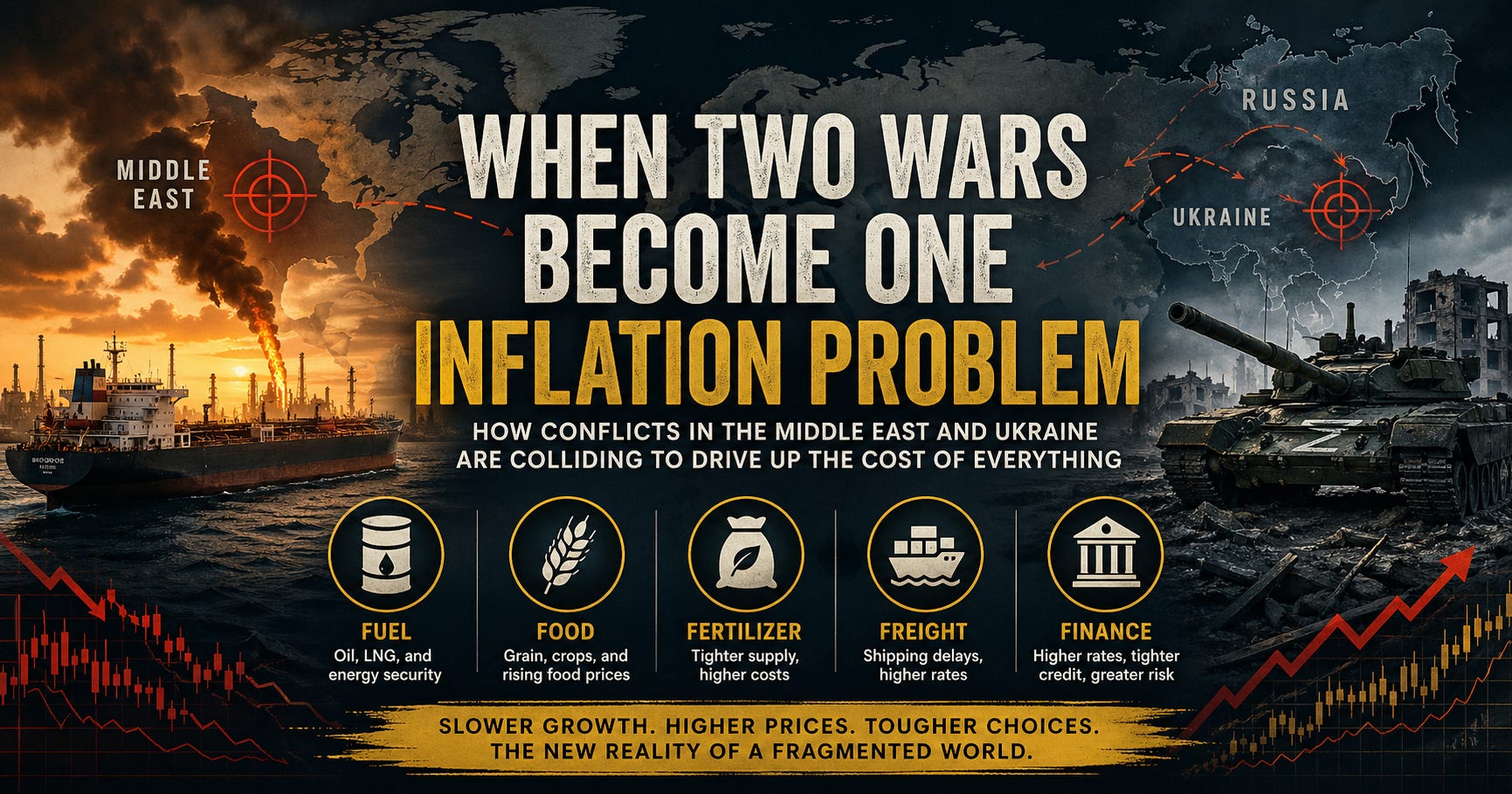
Markets still see separate conflicts. Supply chains do not.
Though the battlefields are thousands of miles apart, insurers and shipping markets are already pricing them as one theater of risk.
A prolonged impasse across both fronts — sustained tension in the Middle East around Hormuz and the Red Sea, while the Russia-Ukraine war continues to disrupt energy, fertilizer, and grain flows — would no longer be two regional stories. It would become one global inflation problem.
This is how major economic shocks often arrive: not through one dramatic collapse, but through several manageable disruptions colliding at once.
The modern economy depends on five things remaining cheap and reliable:
Fuel
Food
Fertilizer
Freight
Finance
When several rise together, markets begin repricing everything. And when inflation persists, finance itself becomes more expensive through higher rates, tighter credit, and reduced risk appetite. The irony of stagflation is that the world needs more supply precisely when higher rates make building it more expensive.
Why This Matters
If Hormuz remains unstable, oil and LNG carry a risk premium.
If the Red Sea remains dangerous, shipping routes lengthen and insurance costs rise.
If the Black Sea remains impaired, fertilizer and grain markets stay tighter than normal.
None of those alone guarantee crisis.
Together, they create a persistent cost squeeze.
That is the foundation of stagflation:
Slower growth
Higher prices
Weaker consumers
More difficult central bank decisions
The Three Scenarios
Scenario 1: Short Shock (0–3 Months)
This is the panic phase.
Prices move first. Reality adjusts later.
Likely outcomes:
Oil spikes sharply
LNG cargoes reroute
Freight rates jump
Fertilizer rises on fear
Airlines, transports, retail weaken
Energy and defense outperform
Governments would likely respond with diplomacy, strategic reserves, and shipping escorts.
Painful, but manageable if routes reopen quickly.
Scenario 2: Grinding Impasse (3–12 Months)
This is where the real damage begins.
What starts as a price spike becomes embedded inflation.
Diesel costs rise. Freight contracts reset higher. Natural gas feeds into fertilizer prices. Fertilizer feeds into crop costs. Crop costs feed into food prices.
This phase often hits emerging markets first.
Likely outcomes:
Higher inflation globally
Slower consumer spending
Pressure on food-importing nations
Subsidy strain for governments
Corporate margin compression
Central banks unable to ease aggressively
Markets stop viewing the issue as temporary.
Scenario 3: Structural Realignment (1–3 Years)
This is where capital adapts.
If instability becomes persistent, the market starts funding alternatives:
New oil and gas projects
LNG expansion
Nearshoring and reshoring
Pipeline and port buildouts
Strategic reserves expansion
Agricultural investment
Defense modernization
The winners in this phase are less about short-term commodity spikes and more about owners of productive assets, infrastructure, logistics networks, and secure domestic supply chains.
Energy infrastructure, LNG exporters, utilities, engineering firms, industrial rebuild names, and resource-rich countries would likely gain relative importance.
The Forgotten Shock: Food
Oil shocks move markets. Food shocks move societies.
Higher fertilizer costs reduce yields or raise crop prices. Higher diesel increases planting, harvesting, and transport costs. Shipping disruption delays grain deliveries. Weak currencies make imports even more expensive.
The result is delayed inflation that lands directly on households and governments.
Countries dependent on imported wheat, corn, edible oils, or fertilizer face:
Rising subsidy burdens
Fiscal stress
Social unrest risk
Currency pressure
Migration pressure
Markets often underestimate food inflation because it moves slower than crude oil. But politically, it can be far more destabilizing.
The Guyana Factor
One of the most important emerging supply stories is Guyana.
Guyana has moved from frontier producer to strategic Atlantic Basin oil supplier in record time through offshore development.
In a prolonged disruption scenario, Guyana matters because it offers:
New barrels outside conflict zones
Production growth already underway
Attractive crude quality
Atlantic shipping access
Low exposure to major chokepoints
It will not replace Gulf supply, but every secure marginal barrel becomes valuable in a tight market.
Likely Beneficiaries
Exxon Mobil
Hess
CNOOC
Offshore service companies
Tanker and logistics firms tied to Atlantic flows
When supply is scarce, incremental growth becomes strategic.
The Venezuela Wild Card
Venezuela is different.
Guyana is a growth story. Venezuela is a recovery story.
Venezuela holds some of the largest oil reserves in the world, yet production remains far below historic potential after years of underinvestment, infrastructure decay, sanctions uncertainty, operational failures, and talent flight.
That gap is the opportunity.
Why It Remains Dormant
Much of Venezuela’s oil is heavy crude that requires:
Upgraders
Blending inputs
Functional pipelines
Reliable power
Export terminals
Skilled labor
Foreign capital
Contract confidence
Venezuela is not a turn-key solution. It is a large latent capacity story requiring time, money, and stability.
Why It Matters
In a prolonged global shortage, few countries can potentially add meaningful new barrels over time. Venezuela is one of them.
Even a moderate recovery could help ease pressure in global markets.
Companies Positioned to Benefit
Producers / Operators
Chevron
Repsol
Eni
Shell
Oilfield Services
Halliburton
SLB
Baker Hughes
Refiners Built for Heavy Crude
Valero
Marathon Petroleum
Phillips 66
PBF Energy
If Guyana is the new engine, Venezuela is the old engine that may run again with enough repair.
The LNG Relief Valve
Oil gets the headlines. LNG may matter just as much.
If Middle East gas flows are constrained, the market would quickly turn toward replacement supply from the Atlantic Basin. In a prolonged disruption scenario, LNG becomes one of the most important pressure-release valves because it can redirect cargoes toward the highest-need markets, particularly Europe, Latin America, and premium Asian buyers.
That puts immediate focus on:
U.S. Gulf Coast export capacity
Trinidad and Tobago Atlantic LNG
Norway
Other Atlantic Basin suppliers
United States Gulf Coast
The U.S. Gulf Coast has become one of the world’s most important swing LNG hubs. Export terminals there can redirect cargoes based on pricing signals and geopolitical need.
If Gulf supply from the Middle East is impaired, U.S. LNG becomes a central replacement source.
Likely Beneficiaries
Cheniere Energy
Venture Global
Sempra
Energy Transfer
Kinder Morgan
EQT Corporation
Pipeline operators, gas producers, liquefaction owners, and LNG tanker firms all stand to benefit if Atlantic cargoes become more valuable.
Trinidad and Tobago – Atlantic LNG
Trinidad and Tobago remains strategically relevant because Atlantic LNG is one of the key LNG export platforms in the Atlantic Basin.
That matters because Trinidad already has the infrastructure, shipping position, and operating experience. In a prolonged disruption scenario, restored upstream gas supply could quickly increase its strategic importance.
Likely Beneficiaries
Shell
BP
National Gas Company of Trinidad and Tobago
Atlantic LNG stakeholders
Local marine, service, and industrial sectors
For Trinidad specifically, stronger LNG economics can improve:
Export revenue
Foreign exchange inflows
Government revenue
Industrial confidence
Downstream petrochemical competitiveness
Why LNG Matters More Than Many Think
LNG is not just a power-generation fuel.
It feeds:
Electricity systems
Fertilizer production
Petrochemicals
Industrial heat
Grid stability
So gas shortages often become fertilizer shortages. Fertilizer shortages often become food inflation.
That chain matters.
Strategic Bottom Line
If oil is the first shock, LNG can be the first relief valve.
When pipeline gas is limited and chokepoints are stressed, the world pays up for flexible molecules. Atlantic Basin LNG would become one of the most valuable balancing tools in the system.
Who Wins and Who Loses
Likely Winners
Energy producers
LNG exporters
Fertilizer companies
Defense contractors
Utilities
Gold
Select industrial and infrastructure names
Secure-resource countries
Likely Losers
Airlines
Cruise lines
Consumer discretionary retail
Chemicals
Freight users without pricing power
Highly leveraged growth stocks
Import-dependent nations
Bottom Line
If both conflicts drag on, markets stop asking whether the shock is temporary and start asking where replacement supply can come from.
That changes leadership.
Energy over aspiration.
Cash flow over story.
Resources over promises.
Security over efficiency.
When old arteries clog, the world pays more for new supply.