

It’s 6:30 a.m. on a rainy Saturday morning here in Port of Spain.
The rain has settled in, the dogs are asleep, and after watching them earlier this week conduct what appeared to be a full-scale search operation through the living room, I think they’ve earned the rest.
I’m working through my second espresso.
I haven’t posted as much over the past week as I normally would. Business has been unusually busy, sleep has been in short supply, and something had to give. Hopefully over the coming week the schedule eases enough to get back into a more regular rhythm.
In many ways, that mirrors the market itself this week.
There wasn’t one defining headline.
Instead, there were dozens of smaller stories pulling capital in different directions simultaneously.
The market wasn’t weak.
It was selective.
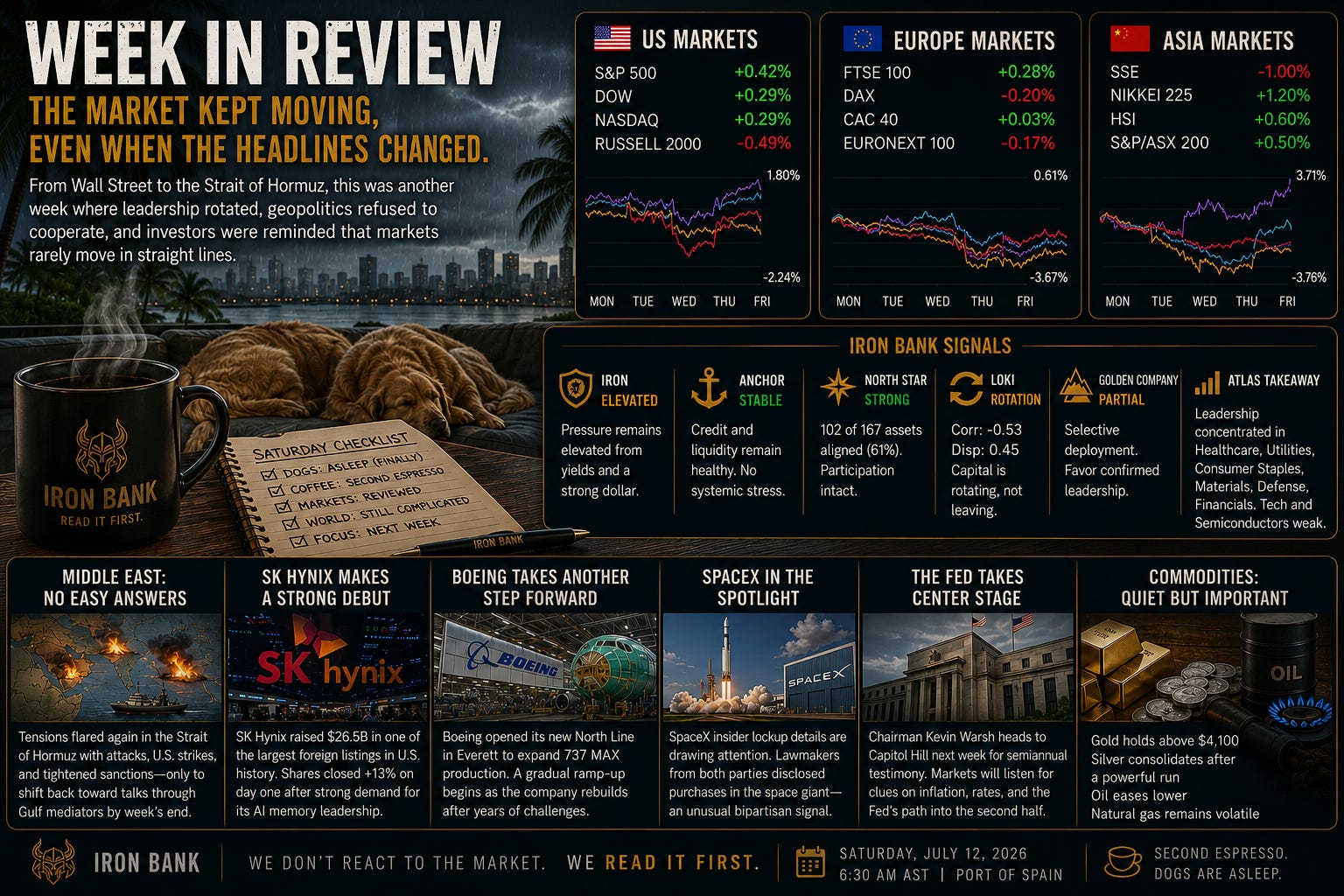
The S&P 500 finished the week comfortably higher while the Nasdaq also advanced, but underneath the surface the picture was considerably more complicated.
Small caps continued to struggle, with the Russell 2000 lagging noticeably behind the large-cap indices.
Europe spent much of the week under pressure before stabilizing into Friday, while Asia remained a tale of multiple markets. Japan continued showing resilience, Hong Kong strengthened nicely, Australia quietly ground higher, while mainland China remained the weakest major market.
That divergence is becoming one of the defining themes of 2026.
Not every market is participating equally.
Iron Bank saw it before the indexes did
One reason I enjoy building Iron Bank is that it forces me to look beneath price.
This week’s readings were particularly interesting.
Iron remained Elevated.
Anchor stayed Stable.
North Star remained Strong with participation holding above 60%.
That combination is important.
It suggests the market structure itself hasn’t broken.
Instead, capital continues rotating aggressively beneath the surface.
LOKI captured exactly that behavior.
Correlation weakened.
Dispersion increased.
Leadership narrowed.
Rotation accelerated.
That’s not what market tops normally look like.
It’s what investors experience when money leaves one group of winners and immediately searches for another.
Defensive leadership isn’t necessarily bearish
Perhaps the biggest surprise this week came from Atlas.
Healthcare.
Utilities.
Consumer Staples.
Materials.
Defense.
Financials.
Those sectors dominated leadership rankings.
Meanwhile Technology and Semiconductors slipped into the weakest categories inside the model.
That immediately raises eyebrows. Normally investors associate defensive leadership with fear.
Sometimes that’s true. Sometimes it’s simply investors becoming more selective after enormous gains elsewhere.
The key distinction is this:
Iron Bank continues describing this as rotation, not structural deterioration and that is an important difference.
Meanwhile, the bond market remained calm
Treasury futures were remarkably stable considering everything else happening globally.
Gold quietly pushed back above $4,100.
Silver continues its consolidation.
Oil drifted lower into the weekend despite another turbulent week in the Middle East.
Natural gas remained volatile.
Taken together, those moves don’t suggest panic.
They suggest markets are continually repricing geopolitical risk without assuming the worst-case outcome.
The Middle East refuses to stay quiet
Unfortunately, that worst-case scenario never completely disappears.
The fragile understanding between Washington and Tehran deteriorated again this week after renewed attacks around the Strait of Hormuz prompted another round of U.S. military strikes against Iranian targets. Oil sanctions were tightened again, while both sides continued exchanging increasingly aggressive rhetoric.
Then, just as quickly, diplomacy reappeared.
By Friday, discussions shifted back toward indirect negotiations through Gulf mediators, even as President Trump declared the earlier ceasefire framework effectively over while confirming that talks would continue.
If there’s one lesson markets continue teaching us, it’s this:
Geopolitics rarely moves in straight lines.
Neither do oil prices.
Corporate America kept moving
Away from geopolitics, several corporate stories stood out.
SK Hynix completed one of the largest foreign listings ever seen in U.S. markets, with exceptionally strong demand and an impressive first day of trading. It highlights that global appetite for AI infrastructure remains very much alive despite periodic volatility in semiconductor shares.
Boeing also quietly delivered one of the week’s more important industrial developments.
The company officially opened its new North Line production facility in Everett as part of its long recovery following years of manufacturing setbacks. Production won’t ramp overnight, but it represents another incremental step toward rebuilding one of America’s most important industrial manufacturers.
Meanwhile, attention continues building around SpaceX.
Investors are already looking beyond the IPO itself toward upcoming insider lock-up dates that could influence supply later this year, while bipartisan congressional purchases of SpaceX shares added another interesting dimension to the investment story.
None of these developments dominate a single trading session.
Collectively, however, they continue reinforcing the broader themes of AI infrastructure, aerospace manufacturing, and long-duration industrial investment.
Looking ahead
Next week probably won’t become easier.
Federal Reserve Chair Kevin Warsh heads to Capitol Hill for semiannual testimony before Congress, with investors looking for any shift in the Fed’s inflation or interest-rate outlook.
At the same time, earnings season begins gathering momentum.
That’s when narratives stop driving prices. Results do.
Final thoughts
This week reinforced something I’ve written repeatedly over the past several months.
The market isn’t giving investors an easy “risk-on” or “risk-off” answer. It’s demanding selectivity. Capital is moving. Leadership is changing. Geopolitical risk remains elevated.
Yet beneath all of that, the broader market structure continues holding together better than many expected. Sometimes the headlines tell you where the market has been. The rotation tells you where it’s trying to go.
I’ll be watching both.
Until next week.