

Executive Summary
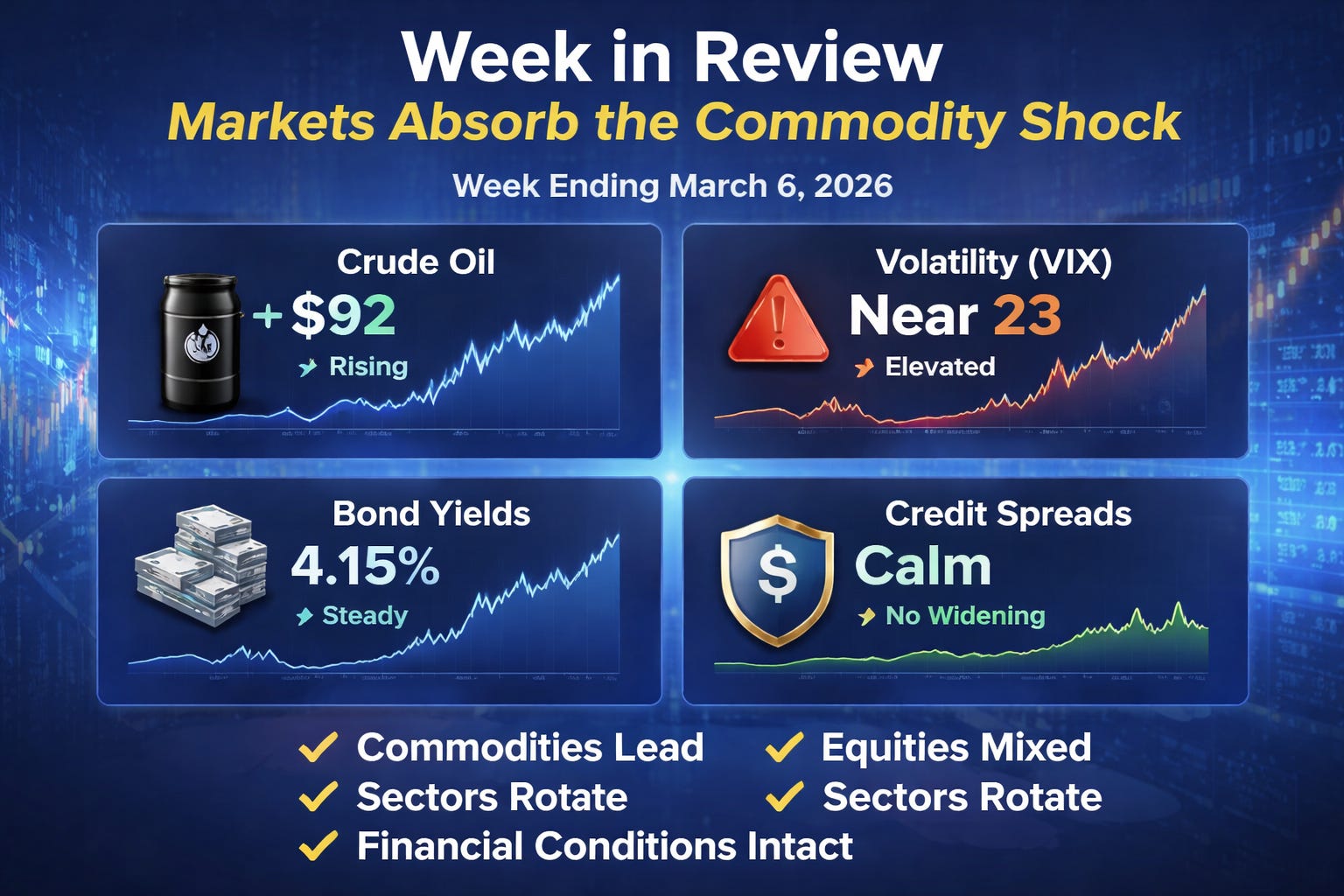
Markets closed the week with commodities firmly in the lead while equities struggled to find direction. Crude oil finished near $92, bond yields held around 4.15%, and volatility remained elevated with the VIX near 23. Despite the stronger inflation signals coming from energy markets, credit conditions remained stable. The overall message from markets was clear: capital is rotating toward real assets rather than fleeing risk entirely.
Energy Drives the Week
The dominant story this week was the sharp move higher in crude oil. Prices climbing toward $92 represent a meaningful shift in the inflation backdrop and reinforce the supply concerns that have been building in global energy markets.
Energy prices rarely move this quickly without broader implications. Oil is a foundational input across transportation, manufacturing, and agriculture. When crude rises sharply, it ripples through freight costs, industrial production, and eventually consumer prices.
Yet the market response was measured rather than panicked. Energy equities and commodity-linked assets attracted strong flows, reflecting a repricing of scarcity rather than a collapse in economic expectations.
Volatility Elevated but Controlled
Market volatility remained elevated throughout the week, with the VIX hovering around 23. While this represents a noticeable rise from the calm conditions earlier in the year, it is still far from levels typically associated with systemic stress.
This matters because volatility often acts as the pressure gauge of financial markets. When volatility rises alongside widening credit spreads and falling liquidity, it can signal deeper instability. That pattern did not emerge this week.
Instead, volatility behaved more like a warning signal than an alarm bell—reflecting uncertainty around energy markets and inflation expectations rather than widespread financial distress.
Credit Markets Stay Calm
One of the most important signals came from credit markets. Instruments such as investment-grade corporate bonds and high-yield debt showed no meaningful widening in spreads.
Credit markets are often the first place stress appears during major financial events. When lenders begin demanding higher compensation for risk, borrowing conditions tighten rapidly across the economy.
The absence of that signal suggests that financial conditions remain intact. In other words, the market is experiencing pressure, but not instability.
Rotation Instead of Liquidation
Taken together, the week’s data points suggest a clear pattern: rotation rather than liquidation.
Capital flowed toward commodities and real assets while equities—particularly small caps—struggled to gain traction. The dollar remained firm, reinforcing the idea that global liquidity conditions have not deteriorated dramatically.
This type of environment often appears during inflationary impulses. Investors reposition toward sectors that benefit from higher input prices while reducing exposure to areas sensitive to tightening financial conditions.
Regime Read
The current regime remains defined by commodity-led pressure with stable financial plumbing.
Energy prices are pushing higher, volatility is elevated, and equities are adjusting to the changing cost environment. Yet the core financial system—credit markets, funding channels, and bond stability—continues to function normally.
This distinction is critical. Markets can absorb rotation and repricing. They struggle when financial infrastructure begins to fracture.
What Could Change the Picture
For the current regime to shift toward broader market stress, several signals would likely need to appear together:
Volatility sustaining above 25
Corporate credit spreads widening meaningfully
Bond yields accelerating higher in a disorderly fashion
Until those conditions emerge, the environment remains one of inflation pressure and sector rotation, not systemic instability.
Bottom Line
The week closed with commodities leading, equities adjusting, and financial conditions still intact. Oil near $92 is a strong signal that inflation pressures remain alive, but markets are responding through capital rotation rather than panic.
The system is under pressure—but it is still functioning.