

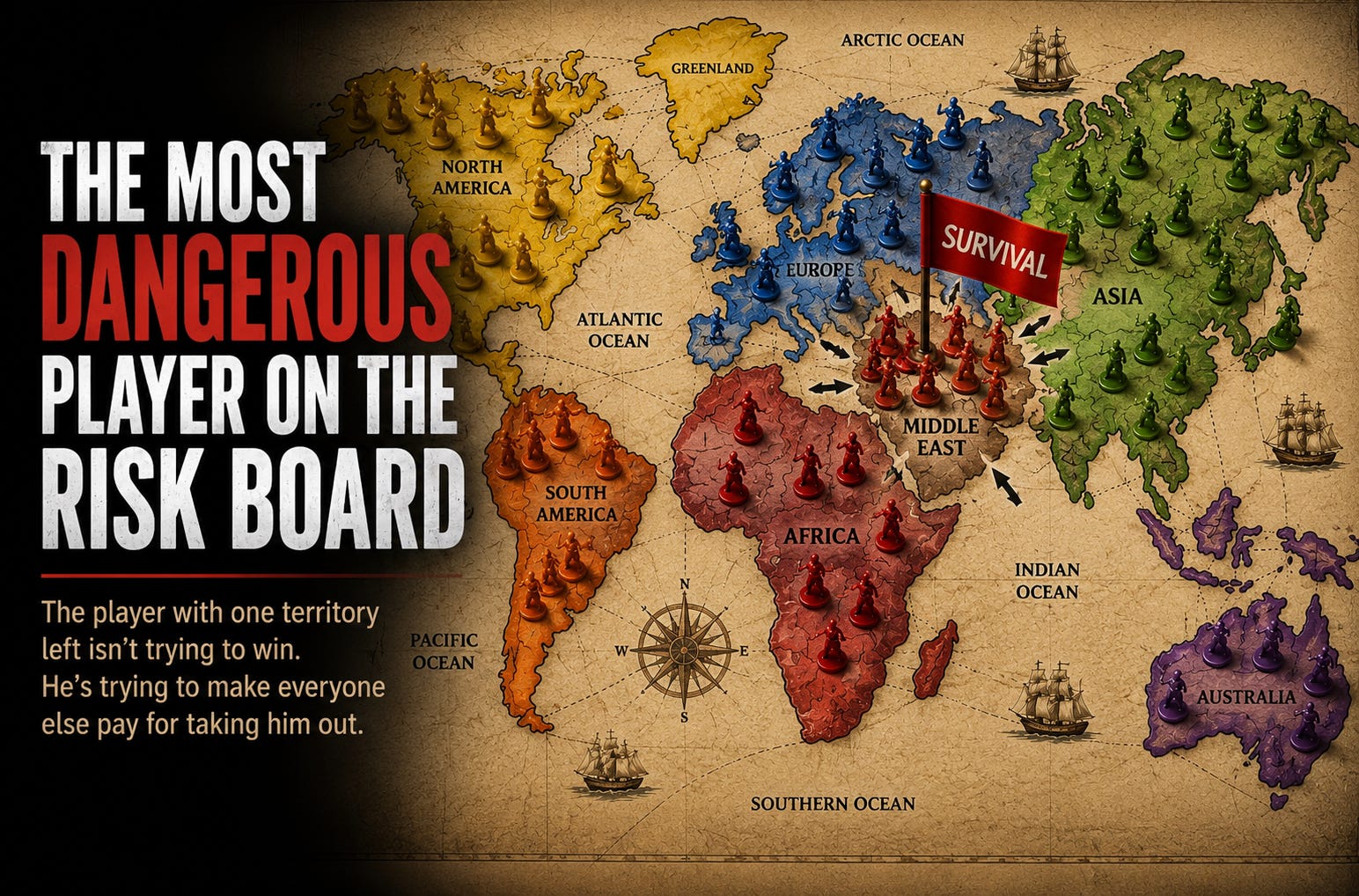
Imagine six players sitting around a Risk board. Five of them are still competing for victory. One of them is not.
That player has been pushed back to a single region. His supply lines are gone. His ability to project power is limited. He no longer has enough territory to dictate terms or shape the direction of the game.
On paper, he is losing.
But something changes when a player reaches that stage.
The objective is no longer to win.
The objective becomes survival.
Every turn, he launches attacks into neighboring territories. Not because he expects to conquer the board, but because he wants to raise the cost of eliminating him. He builds armies on his final territory while continuously inflicting damage on anyone within reach.
The calculation is simple.
If taking his last territory costs an opponent twenty armies, nobody wants to be the one to do it. The player who delivers the Coup de grâce may collect the cards, but he also weakens himself enough that another rival can immediately take advantage.
The result is a strange form of deterrence.
The weaker player survives not because he is strong enough to win, but because he is dangerous enough to punish whoever attacks him.
Iran increasingly resembles that player.
Closing shipping lanes. Supporting proxy groups. Launching limited retaliatory strikes. Creating uncertainty in energy markets. None of these actions change the balance of power. But they do increase the cost of pressure.
The Strait of Hormuz closure is not a path to victory. It is a tax on whoever applies pressure next. The proxy network is not an empire. It is a set of trip wires designed to raise the cost of any direct confrontation. The missile and drone campaigns are not conquests. They are signals that elimination will not come cheaply.
Much of the commentary surrounding Iran assumes that every action is part of a strategy designed to achieve dominance. But what if the objective has already changed?
What if the goal is no longer expansion or influence?
What if the goal is simply to make the final move so expensive that nobody wants to be the one to make it?
That does not mean the strategy succeeds. History is full of examples where this approach eventually fails. The cornered player still loses the game more often than not.
But it does explain behavior that otherwise appears irrational.
A cornered player is not trying to dominate the board.
A cornered player is trying to make the battle so expensive that everyone hesitates before taking the final territory.
The board changes. The pieces change. The objective changes.
When survival becomes the goal, victory is measured not by what you gain, but by how much it costs everyone else to remove you.