

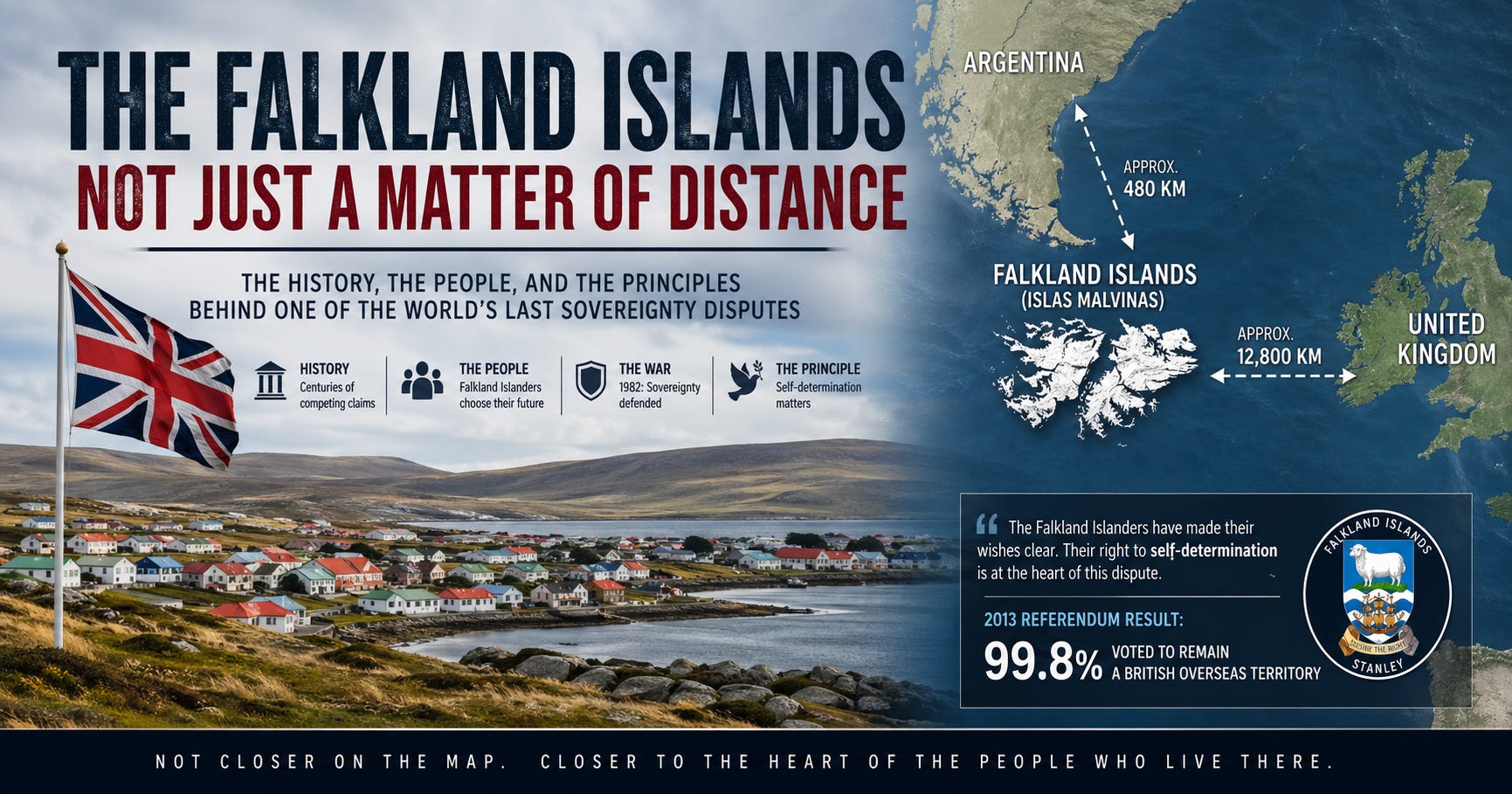
A post circulating on X this week reignited the familiar claim that the Falkland Islands are simply “closer to Argentina than Britain,” therefore the issue should be obvious. That kind of viral framing spreads quickly because it feels simple.
The problem is that simplicity is doing all the work.
Every few years the Falkland Islands return to headlines, usually through renewed rhetoric from Argentina or commentary from observers who reduce the issue to distance from the British mainland.
That framing misses the real story.
The Falklands are not simply a remote island chain sitting closer to Argentina than Britain. They are a sovereignty dispute shaped by history, war, deterrence, domestic politics, and the principle of self-determination. Anyone treating it as a matter of map coordinates is skipping the entire substance of the debate.
A Dispute Older Than Most Modern Governments
The roots of the argument stretch back centuries. British, French, and Spanish claims overlapped in the 18th century. After Argentine independence in the 19th century, Buenos Aires asserted succession to earlier Spanish claims. Britain reasserted control in 1833 and has maintained continuous administration since.
That history matters because both sides build their legal and political arguments from different starting points.
Argentina argues the islands are a colonial holdover located near its coast and tied historically to the region.
Britain argues it has long-standing administration and that the decisive modern factor is the will of the people living there.
Those are not the same argument, which is why the issue never fully disappears.
The War Changed Everything
The Falklands War transformed the dispute from diplomatic argument into strategic memory.
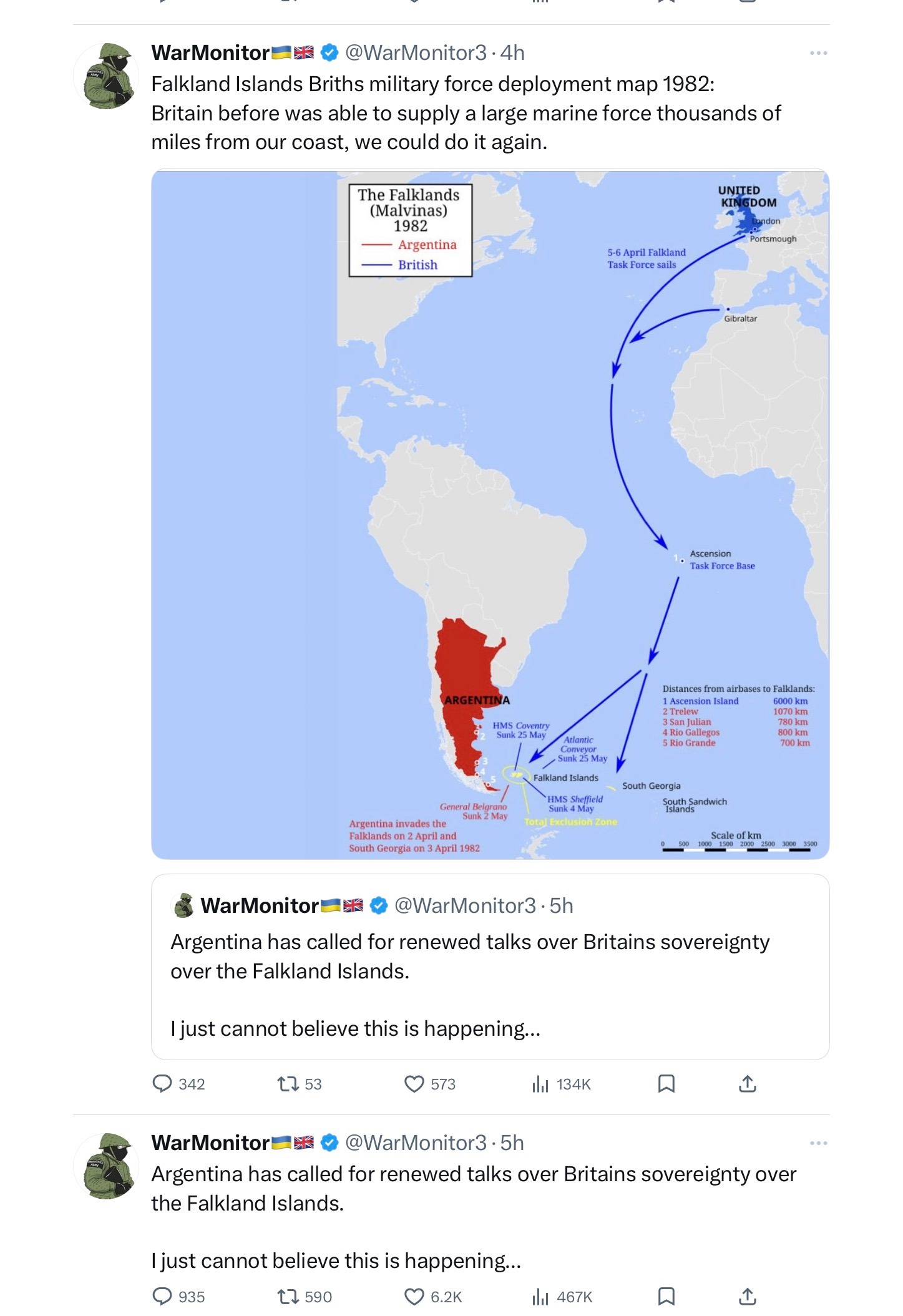
When Argentina’s military junta invaded in 1982, Britain responded by sending a naval task force thousands of miles to retake the islands. The war lasted 74 days and ended with Argentine surrender.
That conflict still shapes the modern calculation.
For Britain, the islands became proof that sovereignty claims backed by force would be resisted.
For Argentina, the loss became a national scar that still carries political resonance.
Wars do not always settle disputes legally, but they often reshape the cost of reopening them.
Why the Islanders Matter Most
The strongest modern British argument is not empire. It is self-determination.
In 2013, Falkland Islanders voted overwhelmingly to remain a British Overseas Territory. For London, that vote is central: the people who live there have expressed their preference.
This is where many simplified arguments fail. The debate is no longer only about historic claims. It is also about whether the wishes of current residents matter.
If they do, Britain’s position strengthens considerably.
If they do not, the argument becomes purely territorial.
That is why this principle sits at the center of every modern discussion.
Why Argentina Keeps Raising the Issue
The Falklands question remains politically useful in Argentina. It can unify opinion, appeal to nationalism, and redirect attention during periods of domestic economic or political strain.
That does not mean the claim is insincere. It means sovereignty disputes often serve internal politics as much as external strategy.
Many countries revive old territorial issues when circumstances at home become difficult.
What the Real Question Is Today
The modern Falklands issue is less about imminent invasion and more about credibility.
Would Britain defend the islands again?
Would Argentina seek diplomatic pressure rather than military options?
Would international actors back self-determination or push negotiations?
Those are strategic questions, not cartographic ones.
Bottom Line
The Falkland Islands debate is not about who sits closest on a map.
It is about competing historical claims, the memory of war, the wishes of the islanders, and whether states still defend commitments far from home.
Maps start the argument. Resolve usually decides the rest.
The Falklands were never only about distance. In 1982, Britain answered that argument decisively — back in control.