

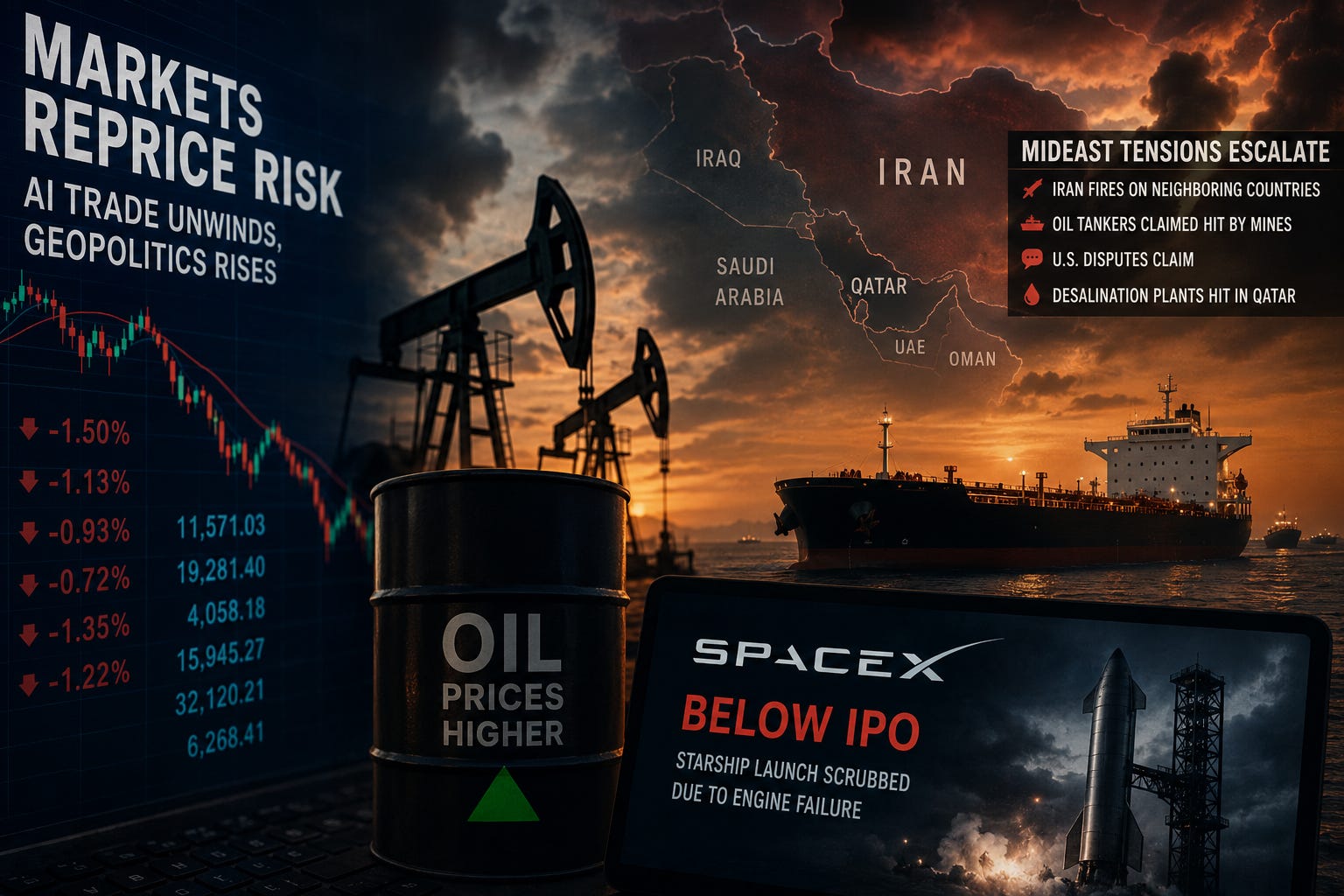
Friday’s selloff looked ugly on the surface, but beneath the major indexes a much more important shift was taking place. Capital was not simply leaving the market. It was moving—away from crowded technology leadership and toward energy, infrastructure, cybersecurity, healthcare and selected industrials as geopolitical risk broadened across the Middle East.
Friday’s close left plenty of red across global markets.
Technology was hit hard. Semiconductors were among the worst performers. Financials weakened. Airlines and consumer discretionary names struggled. Volatility jumped.
At first glance, it looked like a fairly straightforward risk-off session.
But after going through the market sector by sector, that explanation doesn’t quite fit.
There were clear pockets of strength in energy, power infrastructure, cybersecurity, healthcare, aerospace and even some of the market’s more speculative corners.
Meanwhile, the geopolitical backdrop continued to deteriorate.
The United States and Iran intensified attacks across the Gulf. Iran launched strikes toward several neighboring countries, including Kuwait, Iraq, Jordan and Bahrain. A strike damaged a major Kuwaiti power and desalination facility, bringing critical civilian infrastructure directly into the conflict. Oil prices climbed more than 4% on Friday, with Brent settling at $88.10 and WTI at $82.49 as markets priced continued disruption through the Strait of Hormuz alongside the possibility of additional pressure on Red Sea shipping.
Against that backdrop, Friday’s market begins to make considerably more sense.
This wasn’t indiscriminate liquidation.
It was a market adjusting simultaneously to crowded positioning, slowing economic expectations and a growing geopolitical energy shock.
The bull market may not be broken.
But the easy part of the rally may be over.
The Semiconductor Reset
The biggest change in market leadership is happening inside technology.
For much of the recent rally, the AI infrastructure trade expanded steadily outward.
What began with semiconductors broadened into networking, data centers, electrical equipment, power generation, cooling infrastructure and eventually materials.
That broader investment cycle still appears intact.
What has changed is the market’s willingness to buy virtually every semiconductor company simply because it sits somewhere inside the AI ecosystem.
Friday’s numbers were brutal:
Applied Materials -6.9%
Lam Research -3.2%
TSMC -2.9%
ASML -2.4%
Nvidia -2.3%
AMD -1.8%
Intel -3.1%
The selling was global rather than confined to Wall Street, with semiconductor weakness spreading across Asian and European markets as investors continued reassessing one of the most crowded trades of the year.
Yet elsewhere inside technology, the picture looked very different.
Cisco +1.9%
Oracle +1.8%
Arm +1.9%
Nebius +3.6%
Lumentum +3.0%
Akamai +1.4%
Dell +1.2%
Equinix +1.1%
That’s an important distinction.
The AI trade doesn’t necessarily appear to be ending.
Instead, the market may finally be asking the question it probably should have been asking all along:
Who is actually going to earn the next dollar of AI infrastructure spending?
The next phase of the investment cycle could become considerably more selective.
Networking
Optical connectivity
Data centers
Power
Electrical infrastructure
Specific compute platforms.
The days when simply being adjacent to AI was enough may be disappearing.
Energy Has Become Leadership
The clearest strength across Friday’s market came from energy.
The breadth was difficult to ignore.
Venture Global +9.2%
Woodside Energy +5.8%
Eni +3.6%
Valero +3.5%
APA +3.2%
Shell +2.8%
Canadian Natural Resources +2.7%
EOG +2.6%
Occidental +2.4%
Chevron +2.2%
Cheniere +2.2%
ConocoPhillips +1.9%
BP +1.8%
ExxonMobil +1.3%
This wasn’t simply one or two oil companies reacting to higher crude.
It was broad sector participation.
And the geopolitical backdrop continued giving investors reasons to add an increasingly large risk premium.
The United States and Iran continued trading strikes as their confrontation over control and freedom of navigation through the Strait of Hormuz intensified. Commercial shipping through the region has already been substantially disrupted, and oil markets are now also considering the possibility that Red Sea routes could face further pressure. Brent and WTI both reached their highest levels in more than a month on Friday.
The maritime situation has become increasingly difficult to decipher.
Iran has blamed some tanker incidents on mines, while Washington has disputed elements of Tehran’s account of events in and around the Strait.
For markets, however, attribution may increasingly be secondary to the immediate economic consequence.
Tankers are moving through an active conflict zone. Ships are being attacked as naval forces are operating nearby. Insurance costs rise, crews become more difficult to secure which makes shipping companies hesitate.
Every incident adds friction to one of the world’s most important energy corridors.
The conflict is therefore no longer simply about whether the Strait is technically open or closed.
Markets now have to price:
Restricted shipping.
Mine risk.
Higher insurance premiums.
Attacks on tankers.
Damage to oil infrastructure.
Potential disruption to LNG.
And the possibility of the conflict spreading further across regional shipping lanes.
Energy has consequently moved beyond its role as portfolio insurance.
For now, it is genuine market leadership.
And the longer the confrontation continues, the greater the possibility that oil becomes the primary transmission mechanism through which the war spreads into the global economy.
Higher crude reaches transportation costs
Then freight
Then airlines
Then consumer spending
Then inflation expectations
And eventually monetary policy
Friday’s market may already have begun pricing that chain.
The Geopolitical Risk Premium Is Expanding Beyond Oil
The most consequential development may be that the conflict is no longer confined to military installations and energy infrastructure.
Iranian strikes have increasingly reached neighboring Gulf states.
On Friday, a major power and desalination facility in Kuwait was damaged, highlighting a vulnerability that rarely receives the same attention as oil but may be just as strategically important to the region. Kuwait depends on desalination for the overwhelming majority of its drinking water, and Gulf states more broadly rely heavily on coastal desalination infrastructure.
That changes the nature of the risk.
A refinery can disrupt fuel supplies.
A damaged export terminal can reduce oil flows.
But attacks on water infrastructure introduce an entirely different category of vulnerability.
The Gulf’s desalination facilities are not optional conveniences.
They are lifelines.
That means the regional risk premium now potentially encompasses:
Energy security
Shipping
Water security
Electricity generation
Industrial production
Aviation
Insurance
Civilian infrastructure
Markets are increasingly being asked to price a conflict whose economic perimeter continues expanding.
That makes the situation considerably more difficult than a conventional oil shock.
Industrials Are Splitting Into Two Camps
The industrial complex produced another interesting divergence.
Several companies tied directly to the physical economy and long-duration capital spending held up remarkably well.
GE Vernova +2.1%
GE Aerospace +1.0%
Eaton +0.4%
Caterpillar +0.3%
Carpenter Technology +3.5%
Meanwhile, several companies closely associated with the AI data-center buildout struggled.
That suggests the underlying infrastructure investment cycle hasn’t disappeared.
Instead, the market may be reducing exposure where valuations and expectations have become stretched.
The longer-term themes remain intact:
Grid modernization
Power generation
Electrical infrastructure
Heavy machinery
Strategic materials
The difference now is price discipline.
Investors still appear willing to own the infrastructure buildout.
They’re simply becoming less willing to pay anything for it.
Space Remains Strong—With One Very Notable Exception
One of the more interesting signals came from space and satellite stocks.
Against a weak Nasdaq:
AST SpaceMobile +6.1%
BlackSky +3.2%
Planet Labs +2.2%
Rocket Lab +1.3%
Yet the industry’s most prominent company moved sharply in the opposite direction.
SpaceX shares continued falling below their $135 IPO price after Thursday night’s highly anticipated Starship test flight was automatically scrubbed because of engine problems during the launch sequence. Elon Musk subsequently said two Raptor engines would need to be replaced before another attempt. SpaceX shares fell again Friday, extending a five-session losing streak and closing below the IPO price for a second consecutive day.
That makes the broader strength across space even more interesting.
SpaceX’s decline appears tied at least partly to a company-specific execution setback rather than investors abandoning the commercial-space theme.
While SpaceX was being sold, several publicly traded space and satellite companies moved strongly higher.
That tells us something important.
Risk appetite hasn’t disappeared.
It has become selective.
And that’s one of the reasons I wouldn’t yet interpret the current correction as the beginning of a broad bear market.
In a genuine liquidation, speculative growth tends to get thrown overboard first.
Friday, plenty of it didn’t.
Defense Is Not Trading as One Big War Basket
Given the geopolitical backdrop, you might expect every defense company to rally.
That didn’t happen.
There was clear strength in selected names:
Leonardo DRS +3.6%
Northrop Grumman +1.4%
BAE Systems +1.9%
But elsewhere:
AeroVironment -4.5%
Axon -6.1%
BWX Technologies -1.5%
Leidos -1.7%
Kratos -1.6%
This is another sign of a market that has become considerably more discriminating.
Investors aren’t simply buying anything labeled “defense.”
They’re separating traditional primes, communications, ISR, tactical technology, drones and nuclear exposure.
Even in sectors with strong structural tailwinds, valuation still matters.
Financials Are Sending a Warning
If there’s one part of Friday’s market that deserves particularly close attention, it’s financials.
Weakness was widespread.
Goldman Sachs -2.6%
Regions Financial -2.2%
Ally Financial -2.1%
BlackRock -1.8%
Visa -1.8%
Capital One -1.7%
Citigroup -1.7%
Interactive Brokers -1.6%
European financials were also generally weak.
Japanese banks were worse.
Banks often provide one of the cleaner windows into how markets are thinking about economic growth, credit demand and the yield curve.
Right now they’re not signaling confidence.
The simultaneous weakness across:
financials
airlines
consumer discretionary
portions of transportation
is the most concerning cluster beneath the market.
That’s the part of Friday’s action that can’t simply be dismissed as semiconductor profit-taking.
The Consumer Is Becoming a Bigger Question
Consumer-sensitive sectors also showed considerable weakness.
Airlines were particularly ugly:
Allegiant -4.3%
American Airlines -4.0%
JetBlue -3.9%
United -2.9%
Southwest -2.9%
Delta -2.8%
Alaska Air -4.9%
Housing-related companies also struggled.
Home Depot -2.6%
Builders FirstSource -2.8%
Restaurants weren’t much better.
Starbucks -2.6%
Yum Brands -2.2%
McDonald’s -2.1%
Papa John’s -2.2%
Some of this may ultimately connect directly back to energy.
Airlines are among the clearest victims of a sustained oil shock.
Fuel expenses rise almost immediately.
But the effects don’t stop there.
Higher energy costs eventually pressure freight.
Then distribution.
Then household budgets.
The consumer gets squeezed from both sides—higher prices and potentially slower economic activity.
If oil remains elevated, consumer discretionary may therefore become one of the most important sectors to watch.
Transports Aren’t Confirming a Recession—Yet
Transportation provided a mixed signal.
Union Pacific +1.2%
Norfolk Southern +1.3%
But:
J.B. Hunt -2.4%
FedEx -1.3%
Old Dominion -1.4%
The distinction appears to be between parts of the economy connected to domestic bulk freight and those more exposed to consumer activity, fuel costs and discretionary demand.
That’s not an outright recession signal.
But it’s certainly not confirmation of accelerating economic growth either.
If the rails eventually join airlines and trucking on the downside, the picture becomes considerably more concerning.
They haven’t yet.
Healthcare Is Starting to Behave Like a Defensive
While traditional consumer staples provided surprisingly little protection Friday, healthcare performed considerably better.
Johnson & Johnson +1.1%
Eli Lilly +0.7%
Sanofi +0.9%
Bristol Myers +0.5%
AbbVie +0.3%
Biotechnology was considerably more selective.
There were sharp winners and equally sharp losers.
Again, that’s not panic.
That’s a stock-picker’s market.
Capital is still willing to take risk where investors believe the individual story justifies it.
Cybersecurity Quietly Emerges
One of Friday’s strongest technology groups received relatively little attention.
Cybersecurity.
Zscaler +2.4%
Palo Alto Networks +1.5%
Varonis +1.2%
CrowdStrike was only modestly negative.
Against the broader weakness in technology, that’s notable relative strength.
Cybersecurity now deserves to be included alongside energy, power infrastructure, selected aerospace and networking as one of the areas demonstrating resilience beneath the major indexes.
The Macro Combination Is Uncomfortable
The broader cross-asset picture adds another layer.
Volatility jumped
Treasury yields declined
Long-duration bonds strengthened
Gold moved higher
Oil surged more than 4%
Technology sold off
Energy rallied
That isn’t the signature of one simple macro trade.
The market appears to be pricing two conflicting risks simultaneously.
The first is slower economic activity.
The second is renewed inflation pressure.
Normally, falling Treasury yields would provide support for growth stocks.
Friday, they didn’t.
That suggests technology’s immediate problem wasn’t primarily interest rates.
It was positioning, expectations and valuation.
At the same time, oil and gold rising together suggests investors are increasingly willing to pay for geopolitical protection.
The problem is that this creates an awkward environment for central banks.
If economic activity slows while oil remains elevated, policymakers could eventually find themselves facing weaker growth without the clean disinflationary backdrop normally associated with it.
That is a considerably more difficult market environment than a conventional growth scare.
The Global Warning
The technology weakness is not confined to Wall Street.
Asian chip stocks were also hit hard as the semiconductor selloff spread internationally.
That matters because crowded trades increasingly operate globally.
When positioning unwinds, it rarely respects national borders.
The key question is whether the selling remains contained primarily to technology or begins contaminating the rest of the global risk complex.
So far, that contagion remains incomplete. Small caps have held up better than the Nasdaq. Selected speculative growth companies remain strong. Energy is leading, healthcare is holding, cybersecurity is attracting capital.
That still looks more like rotation than wholesale de-risking.
But the line between the two can become thin very quickly.
What Comes Next?
My base case heading into next week is continued volatility and consolidation.
I would put the probability of that scenario around 60–65%.
The Nasdaq is likely to remain the most vulnerable major index while the semiconductor complex searches for support.
There will almost certainly be sharp rallies along the way.
The question is whether those rallies attract sustained buying or simply provide opportunities for investors to reduce crowded positions.
Meanwhile, capital may continue rotating toward:
Energy
Power infrastructure
Industrial capital expenditure
Selected materials
Cybersecurity
Healthcare
Aerospace and space
The more bullish scenario would require semiconductor selling to exhaust itself, volatility to retreat and buyers to return aggressively to the major technology leaders.
The bearish scenario is more straightforward.
Oil continues higher.
The U.S.-Iran conflict spreads.
Commercial shipping deteriorates further.
Critical infrastructure across the Gulf comes under additional attack.
Volatility pushes through 20.
Financials continue weakening.
Transports roll over.
And, most importantly, small caps lose their relative resilience.
That’s the point where Friday’s rotation begins turning into genuine de-risking.
We’re not there yet.
The Bottom Line
Friday’s market was ugly.
But it wasn’t indiscriminate.
The most crowded parts of technology were hit hard while energy surged, cybersecurity strengthened, healthcare held up, power infrastructure remained resilient and speculative capital continued appearing in selected aerospace and space companies.
At the same time, the geopolitical backdrop became considerably more dangerous.
Oil is no longer reacting to a hypothetical threat around the Strait of Hormuz.
Commercial shipping is already operating under severe disruption.
The United States and Iran continue trading attacks.
Iran has struck neighboring states.
Critical water and power infrastructure has now been damaged.
And oil is increasingly becoming the mechanism through which the conflict can spread from the Middle East into the global economy.
The market therefore appears to be undergoing two adjustments at once.
The first is internal: A reset in crowded AI and technology positioning.
The second is external: A widening geopolitical risk premium.
That combination may explain why Friday felt so different. Investors weren’t abandoning risk entirely. They were changing what kinds of risk they were willing to own.
The message may ultimately be simple:
The bull market hasn’t necessarily broken.
But the easy part of the rally may be over.
The market increasingly appears to be saying:
I still want risk. I just don’t want to pay any price for it.
For the next several sessions, the major indexes may actually tell us less than the sectors underneath them.
The key question isn’t simply whether the S&P 500 or Nasdaq goes up or down.
It’s whether capital continues rotating beneath the surface or whether the pockets of strength finally begin breaking down as well.
That will tell us whether this is simply the next phase of the bull market.
Or something considerably more consequential.