

The headlines said “selloff.”
The watchlists told a different story.
Friday was not broad liquidation. It was not a credit event. It was not even a classic fear-driven panic.
It was a leadership reset.
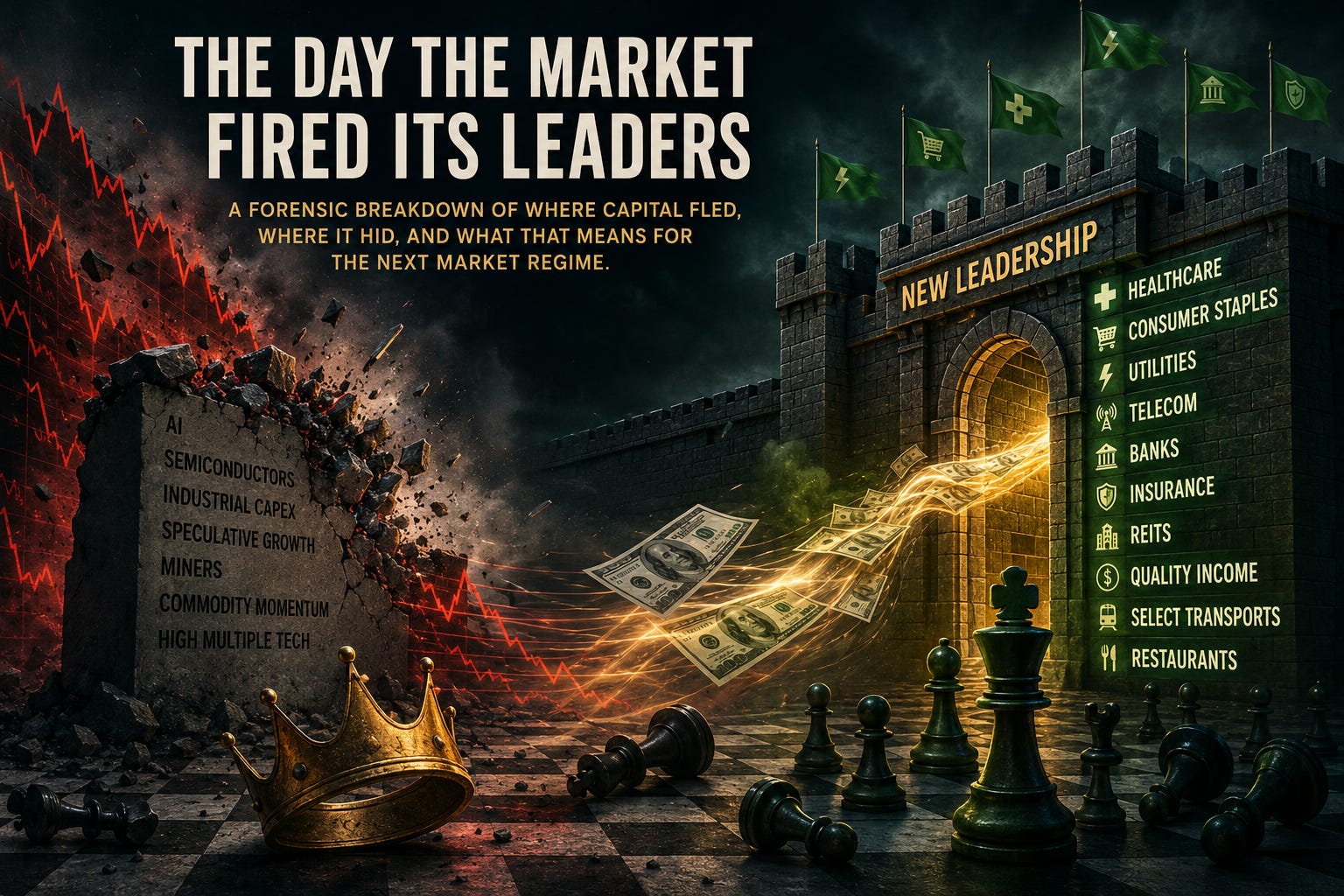
The market aggressively sold what had worked for months—AI, semiconductors, industrial capex, speculative growth, miners, commodity momentum, and long-duration assets. At the same time, capital flowed into healthcare, consumer staples, utilities, telecom, banks, insurers, REITs, and other cash-generative businesses.
When markets change leadership, the damage often looks worse than it actually is.
Instead of a market-wide collapse, investors appeared to be reallocating capital from high-multiple growth themes into sectors with more predictable earnings and cash flows. The sharp declines in former leaders created the impression of widespread weakness, but beneath the surface, many defensive and income-oriented groups were attracting steady demand.
This type of rotation is important because leadership changes often shape market performance for months afterward. Understanding where money is leaving is only half the story; understanding where it is going can provide a much clearer picture of investor expectations.
The question now isn’t whether stocks fell.
The question is what investors chose to own when they did.
The Macro Message
The headline tape was ugly.
S&P 500 down roughly 2.6%
Nasdaq down roughly 4.8%
Russell 2000 down roughly 3.5%
Technology heavily pressured
Staples, healthcare, utilities, REITs, and dividend-focused assets positive
Volatility increased, but not dramatically.
The VIX rose from roughly 16 at the start of the session to around 21 by the close and that matters.
A move into the low 20s signals stress, not panic.
If investors were genuinely pricing a systemic event, volatility would likely have moved much higher.
Instead, Friday looked more like a controlled repricing beneath the surface.
The market wasn’t selling everything. It was selling specific things.
Rates, Credit, and What Didn’t Break
Treasury yields moved higher.
The pressure was most visible in intermediate maturities, while short rates moved less aggressively.
More importantly, credit markets remained relatively orderly.
High-yield bonds weakened only modestly.
Investment-grade credit also avoided any major breakdown.
That tells us something important.
The market was repricing expensive assets.
It was not repricing solvency.
Translation:
The cost of money rose enough to hurt growth valuations but it did not rise enough to break the system.
Commodities Lost Leadership
Commodities experienced broad weakness.
Gold fell.
Silver fell harder.
Copper weakened.
Oil declined.
Natural gas softened.
Mining equities were among the worst performers anywhere in the market.
One signal stood out. Gold declined while volatility rose.
That is not the behavior normally associated with pure fear. Instead, it suggests liquidity tightening, de-risking, and broad position reduction.
The real-asset trade that had led for much of the year suddenly lost sponsorship.
Before commodities can lead again, they first need to stabilize.
Miners and Metals: The Hardest Hit Area
Few groups experienced damage comparable to miners.
Gold miners, silver miners, copper producers, and uranium-linked names all sold off aggressively.
This was not a routine pullback.
It looked like a crowded trade being unwound.
The inflation and hard-asset trade had become one of the market’s preferred destinations. Friday represented a sharp reversal of that positioning.
A bounce may come quickly.
Sustainable leadership is another question entirely.
For that to happen, gold, silver, copper, and broader commodity markets need to stop falling first.
Industrial Capex Meets Valuation Reality
The AI infrastructure buildout trade finally encountered resistance.
Heavy machinery, electrical equipment, grid modernization, cooling systems, and industrial power beneficiaries all came under pressure.
The market was not rejecting the AI buildout narrative.
It was rejecting the valuation attached to it and that distinction matters.
The long-term story remains intact.
The willingness to pay increasingly extreme multiples does not.
For much of the last year, participation was enough.
Now the market appears to be demanding proof.
Engineering, Construction, and Materials
Engineering and EPC names weakened alongside industrial capex.
Construction materials also moved lower, though far less dramatically.
Chemicals and specialty materials showed broad weakness.
Taken together, these groups are sending a similar message:
Investors are becoming less confident in cyclical growth assumptions.
The sectors are not broken.
They are no longer receiving the benefit of the doubt.
Defense Split Into Two Markets
Defense produced one of the most interesting internal divergences.
Large prime contractors held up relatively well.
Higher-beta defense technology
drone systems
ISR platforms
satellite-linked names were hit much harder.
The market treated established defense cash flow as defensive.
It treated speculative defense technology as growth.
That distinction could become increasingly important if volatility remains elevated.
Core defense remains a stabilizer.
Defense technology remains structurally attractive but tactically fragile.
Utilities Quietly Won
One of the strongest messages came from utilities.
Regulated electric utilities
water infrastructure
waste management
Essential-service providers were among the strongest groups on the board.
At the same time, speculative power themes and nuclear-adjacent momentum trades weakened sharply.
The market still wants electricity. It still wants water. It still wants predictable cash flow. What it no longer wants is paying any price for those themes.
Boring won.
Again.
Energy Lost Momentum
Energy weakened alongside the decline in oil. The large integrated producers held up reasonably well.
Higher-beta energy, LNG, and oil-service names suffered more meaningful pressure.
The sector is not broken. But it is no longer acting as the market’s preferred inflation hedge.
Until oil stabilizes, leadership is likely to remain elsewhere.
Healthcare Returned to Favor
Healthcare was one of the clearest beneficiaries of the rotation.
Large pharmaceutical companies attracted capital.
Healthcare insurers and providers outperformed most cyclical sectors.
Speculative biotech generally struggled.
The pattern mirrors what happened across the broader market.
Profitable necessity businesses were rewarded.
Future-potential stories were not.
Healthcare has quietly re-entered the leadership conversation.
Financials Sent a Useful Signal
Banks were more resilient than many expected.
If investors were worried about systemic financial stress, financials would likely have been under much heavier pressure.
Instead, many banks, payment processors, and financial service firms held up relatively well.
The market currently appears concerned about valuation pressure.
Not credit stress.
For now, that remains an important distinction.
Semiconductors: Ground Zero
The epicenter of the damage was semiconductors.
The weakness extended across the entire ecosystem.
Design.
Manufacturing.
Equipment.
Memory.
Networking.
Servers.
Power infrastructure.
Cooling systems.
Everything.
This was not one stock missing expectations but the market aggressively repricing an entire leadership chain.
Importantly, that does not mean the AI theme is dead. It does mean the trade became crowded and markets have a habit of punishing crowded trades.
The first bounce could be powerful.
But sustainable leadership recovery requires participation beyond a handful of familiar names.
Software and Cybersecurity
Software, cloud infrastructure, and cybersecurity weakened alongside semiconductors.
The damage was less severe, but the message was similar.
The market is becoming less willing to pay premium multiples for future growth.
Fundamentals are increasingly important again.
A surprisingly old-fashioned development.
Telecom, Staples, and Necessities
The winners were remarkably consistent.
Telecom.
Consumer staples.
Household products.
Food and beverage companies.
Healthcare.
Utilities.
Insurance.
These groups share similar characteristics.
Predictable demand.
Stable cash flow.
Lower valuation risk.
Limited dependence on aggressive growth assumptions.
In short, investors rotated toward certainty.
Restaurants and Transports Deserve Attention
Two areas held up better than expected.
Restaurants.
Rails and selected transport operators.
That matters because these sectors often provide useful economic signals.
If investors were aggressively pricing recession, these groups would likely have been much weaker.
Instead, they remained relatively resilient.
For now, they suggest rotation rather than economic collapse.
REITs Refused to Break
One of the more surprising developments was the resilience of REITs.
Many real-estate vehicles held up reasonably well despite higher rates.
That tells us the market was not indiscriminately selling rate-sensitive assets.
It was targeting expensive growth, semi conductors and telecommunications
There is a difference.
The New Leadership Map
For much of the past year, market leadership followed a clear chain:
AI → Semiconductors → Power → Industrial Capex → Speculative Growth
Friday broke that chain.
The emerging leadership map looks different:
Healthcare → Staples → Utilities → Telecom → Banks → Insurance → Quality Income → Select Transports
Whether that shift becomes temporary or durable will determine the next phase of the market.
Four Things to Watch Next
1. Do Semiconductors Stabilize?
Risk appetite rarely improves without semiconductor participation.
This remains the most important leadership test.
2. Does Credit Stay Calm?
Credit markets did not confirm panic.
If that changes, the message becomes far more serious.
3. Do Defensive Leaders Continue Attracting Capital?
As long as staples, healthcare, utilities, telecom, and insurers lead, the regime remains defensive.
4. Do Restaurants and Rails Hold Up?
These remain useful recession indicators.
Right now, they are signaling rotation rather than contraction.
Bottom Line
Friday was not a normal red day it was a leadership break.
The market sold what had become crowded, expensive, and dependent on future expectations.
It bought businesses generating cash flow today.
That shifts the burden of proof:
AI has to prove leadership again.
Industrial capex has to prove demand.
Energy has to prove oil support.
Miners have to prove commodity stability.
The defensive sectors already answered the question.
That’s where the money went.