

Something important happened in markets this week, though most of it occurred in a single session.
For the better part of two years, the AI trade has operated under a relatively simple assumption: the companies building the infrastructure would capture the largest rewards. Semiconductors, hyperscalers, networking, cooling, power, and data center construction became the center of institutional positioning.
Friday’s tape challenged that assumption for the first time in a meaningful way.
Not because investors suddenly stopped believing in artificial intelligence.
And not because the AI trade broke.
But because the market briefly started asking a harder question:
How much future growth is already priced in?
That distinction matters.
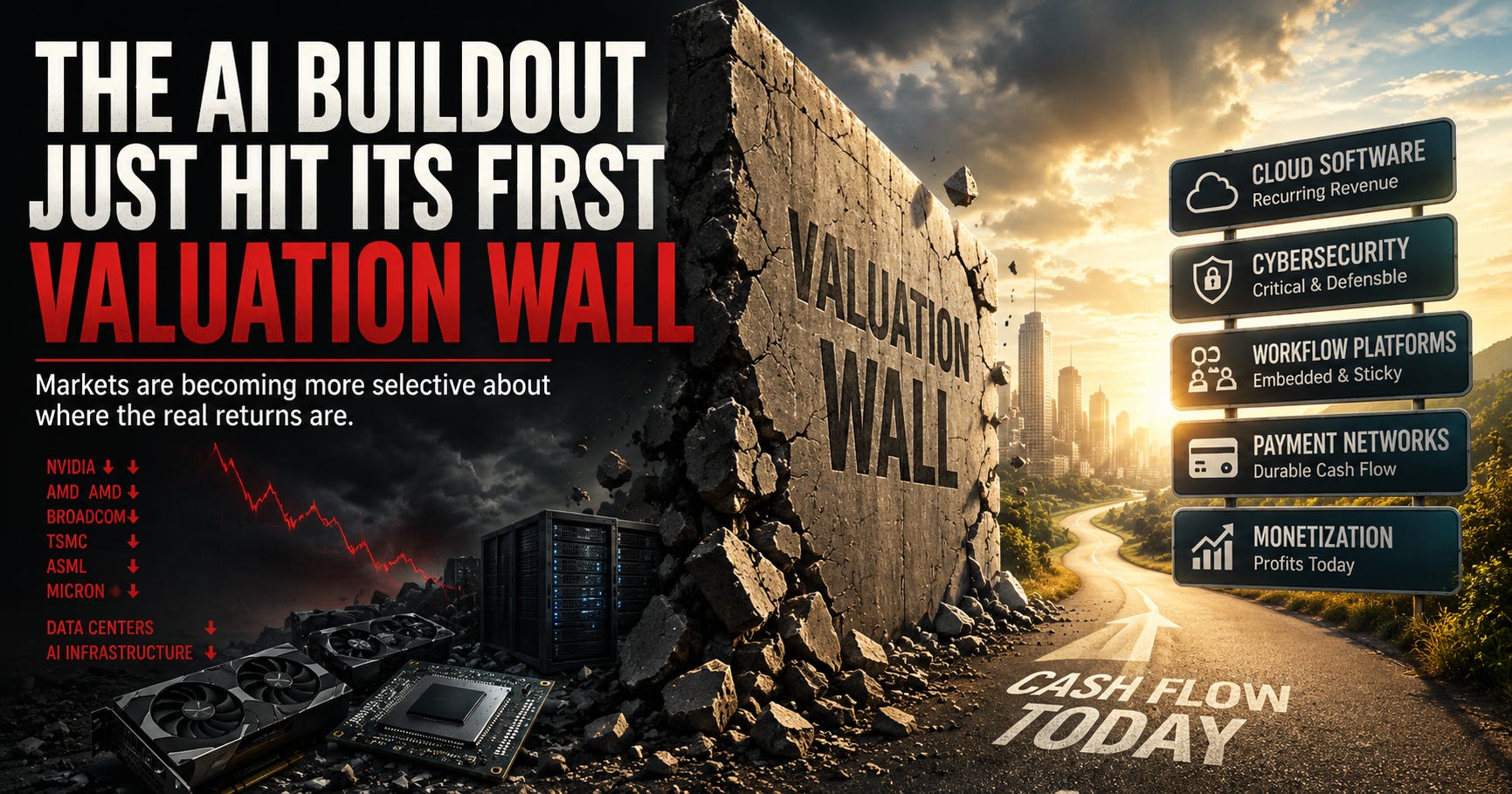
What happened Friday was not a confirmed leadership change. One session does not overturn a multi-quarter trend. But it may have been the first real signal that investors are becoming more selective about where inside the AI ecosystem they want exposure.
And the areas attracting capital were telling:
enterprise software,
cybersecurity,
payment systems,
operational cash flow,
and businesses monetizing AI now rather than years from now.
Meanwhile, large portions of the infrastructure complex suddenly looked vulnerable to valuation compression.
That is not a collapse narrative.
It is the first meaningful stress test of the AI buildout trade.
Friday’s Rotation Was About Monetization
The most interesting part of Friday’s move was not that semiconductors weakened.
It was where the money went instead.
Software and cloud names suddenly caught aggressive bids:
ServiceNow
Salesforce
Adobe
Snowflake
Cybersecurity followed:
CrowdStrike
Zscaler
Palo Alto
These moves stood out because software had spent much of the prior week trading poorly alongside the broader tech complex.
Then Friday, the relationship abruptly changed.
The market started favoring companies with:
recurring revenue,
embedded enterprise positioning,
pricing power,
and immediate AI monetization potential.
That matters because these businesses do not need to spend tens of billions building infrastructure before showing returns.
A company like ServiceNow can integrate AI into workflows corporations already depend on and monetize it through renewals, subscriptions, and seat expansion.
That is a very different economic profile than building hyperscale infrastructure with payoff horizons stretching years into the future.
The message from Friday’s tape looked something like this:
“We still want AI exposure. We’re just becoming more careful about how far into the future we’re paying for it.”
The Semiconductor Weakness Was a Valuation Conversation
It is important not to misread what happened.
Friday’s weakness across semiconductors and AI infrastructure:
Nvidia
AMD
ARM
Broadcom
Micron
ASML
TSMC
was not the market declaring AI finished.
It looked much more like a valuation reset discussion.
The AI infrastructure trade became one of the most crowded trades in global markets. Expectations around hyperscaler spending, compute demand, and data center expansion became enormous.
At the same time, rates remain elevated.
That combination matters because long-duration growth trades become increasingly sensitive to discount-rate pressure when expectations get stretched.
A data center expected to generate major returns seven years from now becomes materially less attractive in a 5% rate environment than it did in a near-zero-rate world.
Friday’s tape looked like the market acknowledging that reality for the first time in a serious way.
Not abandoning AI.
Just questioning how much future growth should already be priced today.
That is a very different conversation.
The Consumer Still Looks Selective, Not Broken
The consumer tape reinforced the same broader pattern.
Areas holding up well:
Coca-Cola
Costco
McDonald’s
Chipotle
Starbucks
TJX
Burlington
Areas remaining weak:
RH
Wayfair
housing-linked discretionary spending
premium financed consumption
This continues to resemble a late-cycle selective consumer rather than a collapsing one.
People are still spending.
But they are prioritizing:
necessity,
affordability,
convenience,
and experience.
What they are avoiding are expensive financing-dependent purchases.
Travel also held together better than expected:
Delta stable,
Marriott orderly,
gaming and leisure firms relatively resilient.
That matters because true labor-market deterioration usually hits travel demand early.
That still is not happening.
Slowdown remains visible.
But the hard-landing signals are still incomplete.
Financials Are Still Containing Stress
Financials quietly offered another stabilizing signal.
If markets genuinely believed a credit event was beginning, banks and payment systems would likely be under significantly heavier pressure.
Instead:
Visa remained firm,
Mastercard strong,
Amex orderly,
Schwab stable,
major banks mostly controlled.
The market is still differentiating carefully between:
leverage-sensitive exposure,
and durable fee-based cash flow models.
That is generally healthier behavior than broad liquidation.
Credit conditions may be tightening, but they still do not appear disorderly.
For now, financials are behaving more like a caution signal than a crisis signal.
The Weak Areas Still Have One Thing in Common
Several structurally weak groups continued struggling:
telecom,
real estate,
leveraged international exposure,
financing-sensitive cyclicals.
The common thread is simple:
higher rates.
Telecom remains pressured because debt-heavy utility-like cash flows become less attractive when refinancing costs rise.
Real estate faces the same problem.
International equities continue struggling under:
stronger dollar pressure,
sovereign refinancing concerns,
and tighter global liquidity conditions.
Markets are increasingly rewarding businesses that:
generate cash flow now,
require less external financing,
and depend less on long-duration assumptions.
That same lens helps explain Friday’s AI rotation.
The Signal That Prevents a Full Bearish Interpretation
Transports still matter enormously here.
J.B. Hunt, Old Dominion, Knight-Swift, UPS, and most rails remained relatively orderly.
Freight activity is difficult to fake.
If the economy were truly moving into a hard recessionary collapse, transport stocks would likely already be pricing severe demand destruction.
That is not happening yet.
Volumes may be slowing.
But goods are still moving.
That keeps the soft-landing interpretation alive — at least for now.
Though it is worth remembering:
transport activity often lags broader credit deterioration by several quarters.
The next round of logistics earnings will matter.
What Friday’s Tape May Have Actually Revealed
The most important takeaway from this week is not that AI leadership ended.
It probably did not.
One session is not enough evidence to make that claim responsibly.
But Friday may have revealed something equally important:
the market may be entering the first real valuation debate phase of the AI trade.
That changes the conversation.
For nearly two years, investors largely rewarded:
scale,
infrastructure,
expansion,
capex,
and future dominance.
Friday’s tape briefly favored something different:
monetization,
margins,
operational durability,
recurring revenue,
and immediate cash flow.
That does not mean semiconductors cannot recover leadership next week.
They absolutely can.
But it does suggest investors are becoming more sensitive to:
duration risk,
valuation concentration,
and the difference between building AI and billing for AI.
And that distinction matters more than many headlines currently suggest.
Because in a world where money is no longer free, markets become far less willing to pay unlimited multiples for profits expected deep into the future.
Eventually, investors start asking a simpler question:
“Who is already collecting?”
Friday’s tape may have been the first real sign that question is beginning to matter.