

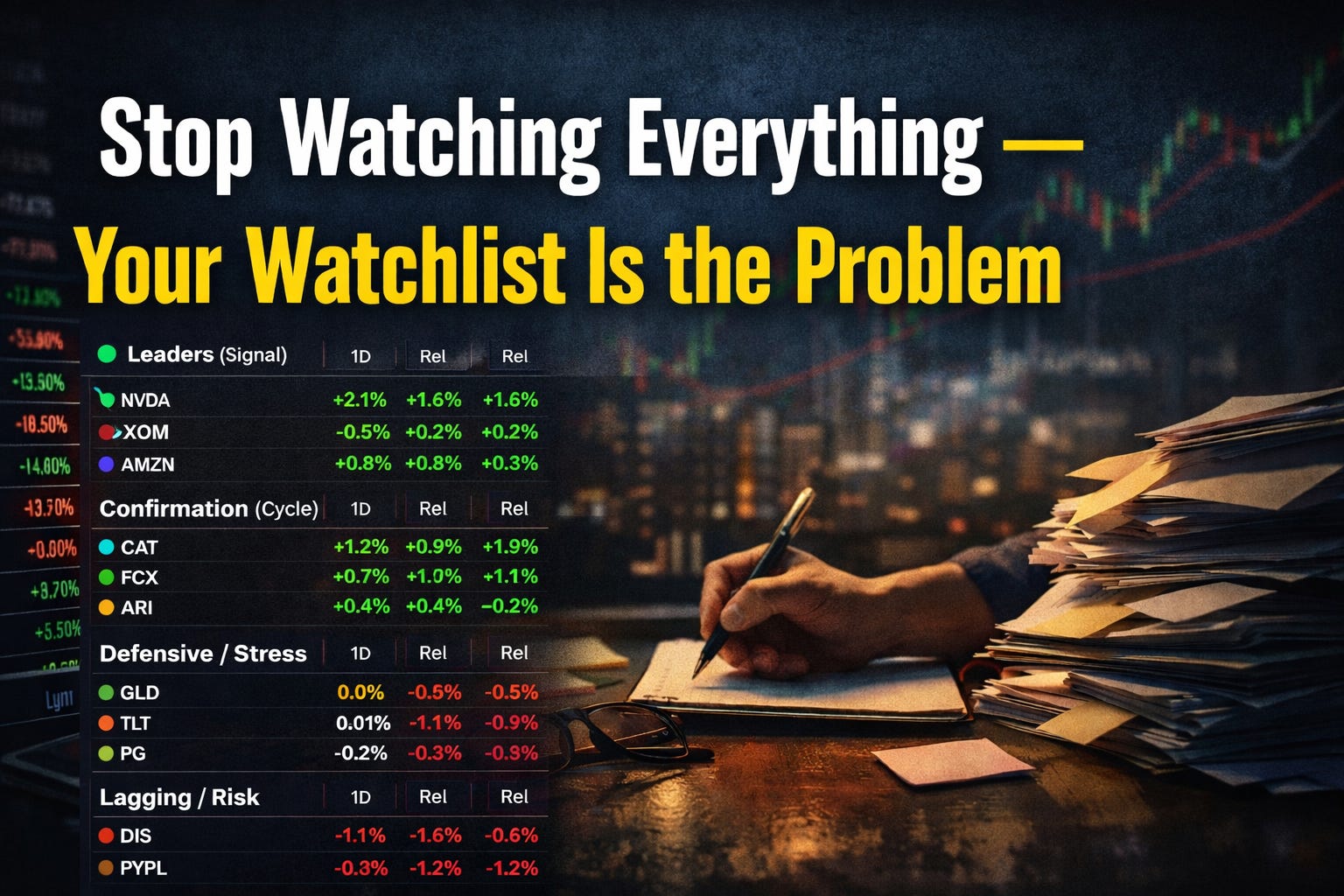
A watchlist is supposed to make decisions easier. Most do the opposite.
What starts as a clean list of ideas slowly turns into a cluttered scroll of tickers—names added out of curiosity, headlines, or boredom. Eventually, it stops functioning as a tool and becomes something closer to a habit. You check it, things move, but nothing becomes clearer. That’s the problem. A watchlist should reduce noise, not create more of it.
The first shift is simple but rarely done: organize by purpose, not by category. Grouping stocks into sectors might look tidy, but it doesn’t tell you anything about what the market is actually doing. The market doesn’t move in neat sector boxes—it moves through leadership, confirmation, and stress. Your watchlist should reflect that.
There are always a handful of names that genuinely drive the tape. These are your leaders. When they move, the market listens. Around them are confirmation names—stocks that don’t lead but should follow if the move is real. Industrials confirming a materials breakout, transports validating growth, that kind of thing. Then you have defensives—utilities, staples, gold—quiet most of the time, but very loud when something is wrong. Finally, there are the laggards, the names that refuse to participate. These are often the most informative because they show you where the market’s story breaks down.
Once you start organizing like this, something clicks. You’re no longer just watching prices. You’re watching relationships.
The next step is cutting the list down. Ruthlessly. Most watchlists are too big to be useful. If you have fifty, sixty, a hundred names, you’re not tracking anything—you’re scrolling. The goal is not coverage. The goal is clarity. Twenty to forty names is more than enough if each one earns its place. Every ticker should answer a simple question: what signal do you give me? If it can’t, it doesn’t belong.
This is where roles come in. Every name should have a defined job. Some are early signals—the canaries. Semiconductors often fall into this category, reacting quickly to changes in risk appetite. Some are drivers, the stocks that actually pull indices higher or lower. Others are confirmation plays, validating whether a rotation has real breadth behind it. And then there are the stress signals—assets that respond when liquidity tightens or fear builds.
Once you assign roles, the watchlist becomes easier to read. A move in a driver matters differently than a move in a laggard. Strength in a confirmation name means something very different from strength in a defensive. Context replaces guesswork.
But structure alone isn’t enough. A good watchlist needs logic. Not complex models—just clear conditions. If oil pushes higher, what should happen next? If rates rise, who breaks first? If leadership narrows, where does the stress show up? These simple “if/then” relationships turn a passive list into an active system. You’re no longer reacting to moves after they happen—you’re watching for the conditions that make them meaningful.
Another common mistake is focusing only on price. Absolute moves can be misleading. A stock can go up and still be underperforming. A sector can look strong but fail to lead. What matters is relative behavior. Is it outperforming the broader market? Is leadership expanding or narrowing? Are winners pulling others with them, or standing alone? These are the questions that reveal whether a move has depth or is just surface-level momentum.
To keep things usable, it helps to simplify status. A basic tagging system is enough. Some names are clearly strong. Some are mixed. Some are breaking. Updating that view daily takes minutes, but it forces you to stay honest about what you’re seeing. Over time, patterns emerge. You start to notice when strength clusters or when weakness spreads. That’s where the real signal lives.
It’s also worth keeping a small rotation sleeve—a separate group for new ideas, emerging themes, or names that might matter but haven’t proven it yet. This is your testing ground. If something starts to behave well, it earns promotion into the main list. If not, it gets removed without hesitation. This keeps the core watchlist clean while still allowing for flexibility.
The final piece is review. Not constant tinkering, but intentional reflection. Daily updates keep you grounded, but weekly reviews give you perspective. Who held up? Who failed to confirm? Where did leadership shift? These questions matter more than any single day’s move. They tell you how the market is evolving, not just what it did.
A properly built watchlist does something very simple: it lets you understand the market quickly. At a glance, you should be able to see who is leading, who is lagging, and whether the story holds together. If leadership is strong and confirmation follows, the move has substance. If defensives are leading while indices drift higher, something is off. If key names stop participating, the signal changes.
That’s the goal. Not prediction, not perfection—just clarity.
Because in the end, a watchlist isn’t about watching everything. It’s about seeing what matters.