

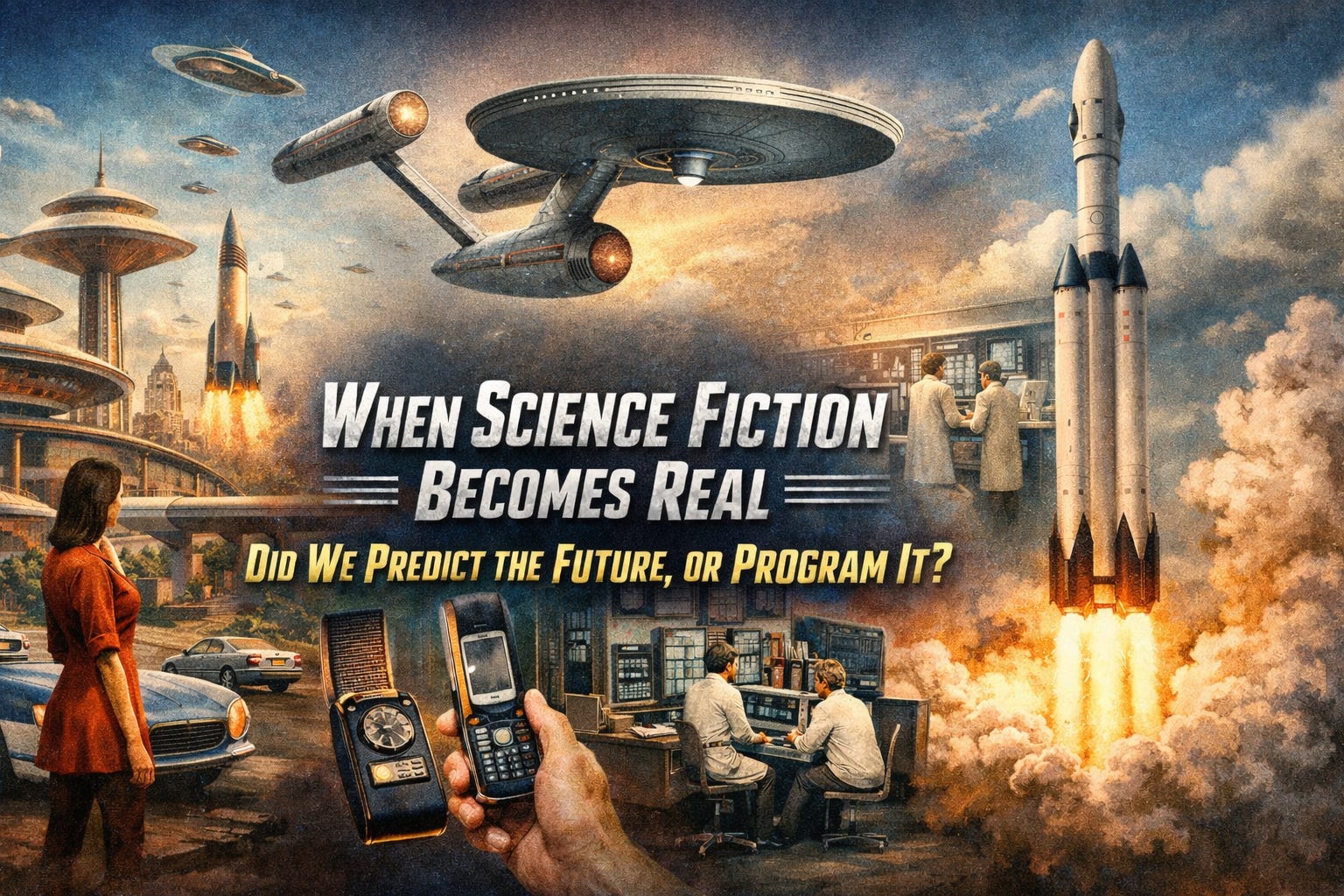
Science fiction didn’t just imagine the future—it quietly built the blueprint for it.
There’s a temptation to treat the genre as prophecy, as if writers somehow glimpsed what was coming. But that’s only half the story. The other half is more interesting—and more uncomfortable. The future didn’t simply arrive. It was, in many ways, constructed by people who grew up reading it.
Engineers, scientists, founders—they don’t emerge in a vacuum. They carry mental models with them, and for generations those models were shaped by science fiction. The people building artificial intelligence today almost certainly encountered Isaac Asimov long before they touched a line of code. The ones pushing the boundaries of space travel were raised on Arthur C. Clarke and Robert A. Heinlein. Even modern industrial figures like Elon Musk have openly admitted that their ambitions were shaped by the stories they consumed.
At that point, the line between prediction and inspiration starts to dissolve. If you grow up believing a thing is possible, you’re far more likely to try to build it.
Take Mary Shelley. When she published Frankenstein in 1818, the scientific understanding of life itself was primitive at best. Yet she landed directly on the core issue that now defines modern biotechnology: not whether we can create life or manipulate it—but whether we should, and what responsibility follows if we do.
That question hasn’t aged at all. If anything, it’s become more urgent.
The pattern repeats across decades. Jules Verne imagined submarines and lunar travel with such detail that later engineers treated his work less like fantasy and more like conceptual sketches. Arthur C. Clarke didn’t just write stories—he described geostationary satellites in 1945 with enough precision that the orbit itself is now named after him. And Philip K. Dick explored surveillance, synthetic identity, and the fragility of reality in ways that feel less like fiction today and more like a product roadmap.
What’s remarkable is that none of these writers were primarily technologists. They were asking human questions—and using imagined technology as a way to explore them.
Then came a shift.
Not just imagining the future—but normalizing how we live in it.
Gene Roddenberry didn’t just write science fiction—he operationalized it. Star Trek is probably the most complete example of fiction not just predicting technology, but shaping the people who would go on to build it.
The communicator didn’t just resemble the modern mobile phone—it directly inspired it. Martin Cooper, who led the creation of the first handheld cell phone, openly credited the show. That’s the pipeline in its purest form: fiction → imagination → invention.
The same pattern shows up everywhere. The PADD tablets predate devices like the Apple iPad by decades. Voice-activated computers, real-time translation, video calls, even automatic doors—ideas introduced as narrative convenience that quietly became engineering targets.
But the technology is only half the story.
What Star Trek did differently was treat the social future with the same seriousness as the technical one.
In 1966, during the Cold War and the Civil Rights era, it presented a bridge crew that looked like a resolved future: a Black woman in a command role, a Japanese helmsman, a Russian officer—all operating as equals. That wasn’t prediction. That was intervention. It normalized a version of society that didn’t yet exist.
It also wrestled with the ethical architecture of power. The Prime Directive—non-interference with less advanced civilizations—isn’t just a plot device. It’s a fully formed foreign policy philosophy. It asks the same question policymakers still struggle with today: just because you can intervene, does that mean you should?
Even the medical side was forward-leaning. Tricorders scanning for disease, remote diagnostics, early explorations of genetic manipulation—ideas that now sit at the center of modern healthcare debates.
Roddenberry wasn’t just imagining better tools.
He was imagining better users.
And that’s what makes this different from the darker strands of science fiction. Where some stories prepare us for failure—runaway AI, dystopian surveillance, collapsing systems—Star Trek prepared us for competence. For cooperation. For responsibility.
It didn’t just normalize fear.
It normalized aspiration.
And that may be the most powerful function science fiction can serve.
Because by the time the technology arrives, we’re not just asking how it works—we’re asking how we’re supposed to behave with it. The script has already been written in fragments, across decades of stories.
So when reality starts to look familiar, it’s not because the future was predicted perfectly. It’s because we’ve been rehearsing it. The real question isn’t whether science fiction became reality.
It’s which version of it we decide to live in.