

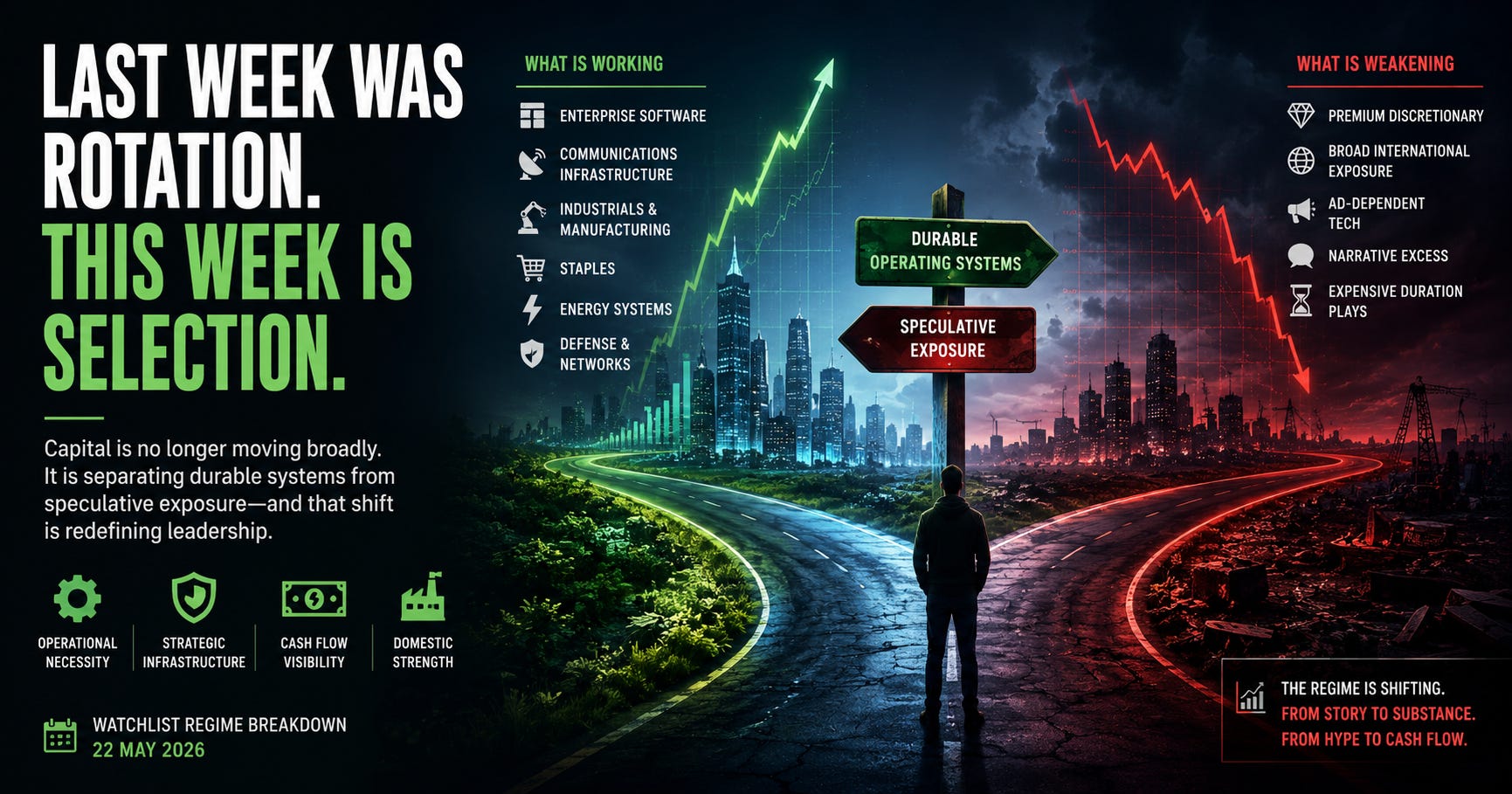
FULL WATCHLIST REGIME BREAKDOWN — 22 MAY 2026
For most of the last two years, markets rewarded narrative first.
If a company could attach itself to AI, disruption, growth, platforms, streaming, cloud, future demand, consumer engagement, or “next generation infrastructure,” capital usually gave it the benefit of the doubt. Valuation discipline weakened. Cash flow mattered less. Duration mattered less. Stories mattered more.
That environment is changing now.
Not collapsing.
Changing.
And what the market is doing across nearly every major watchlist is becoming increasingly obvious:
it is separating necessity from optionality.
That distinction is quietly becoming the entire regime.
The strongest areas of the market now increasingly share the same characteristics:
operational relevance,
recurring demand,
infrastructure exposure,
embedded systems,
pricing power,
domestic strategic importance,
visible cash flow.
Meanwhile the weakest areas increasingly cluster around:
premium discretionary exposure,
speculative duration,
international beta,
expensive narratives,
and business models dependent on constant optimism.
This is no longer random sector rotation.
This is capital becoming selective again.
⸻
I. Technology Is No Longer One Trade
The most important signal on the board may be happening entirely inside technology itself.
Because tech is no longer moving together.
The internal split has become extreme.
Enterprise Software Is Quietly Taking Leadership
The strongest software names are not necessarily the most exciting names anymore.
They are the most operationally embedded names.
Strength continues showing up in:
ZM
SNOW
CRM
FROG
ORCL
NOW
RNG
DOCU
Meanwhile:
MSFT
ADBE
remain stable institutional holdings.
At the same time:
GOOG
GOOGL
have weakened, while even PLTR has shown some softness despite remaining strategically important.
That distinction matters enormously.
The market is no longer simply rewarding “AI exposure.”
It is rewarding monetization visibility.
That means:
workflow ownership,
enterprise integration,
recurring contracts,
operational dependence,
software embedded inside daily business activity.
The tape is increasingly asking a very different question than it asked in 2024:
“Who actually gets paid consistently?”
That is a much more disciplined market question.
And it directly supports the broader thesis that AI monetization is beginning to matter more than raw AI infrastructure excitement.
Infrastructure spending still matters.
But markets are beginning to distinguish between:
companies enabling AI buildout,
and
companies actually converting AI into durable enterprise revenue.
That is a major regime evolution.
⸻
Streaming, Gaming and Digital Platforms: Engagement Still Wins
Consumer digital remains more nuanced.
The market still rewards platforms with engagement dominance and scalable economics.
Strength remains visible in:
SPOT
RBLX
AAPL
while META remains stable.
Meanwhile:
NFLX
DIS
EA
have weakened, while AMZN has softened slightly.
Spotify’s strength is especially interesting.
Because Spotify increasingly trades less like a speculative streaming company and more like a scalable platform monopoly with improving economics and pricing power.
The market still rewards digital ecosystems.
But it is becoming increasingly selective about which ecosystems possess durable margins and sustainable operating leverage.
That distinction matters.
⸻
Communications Infrastructure Is Becoming Strategic Infrastructure
One of the strongest and most important groups in the market right now is communications infrastructure.
And most investors still do not fully appreciate what is happening there.
Strength continues appearing in:
IRDM
VSAT
NOK
ERIC
while:
TMUS
VZ
CMCSA
remain stable.
Weakness continues in:
CHTR
SATS.
But the larger story matters more than the individual tickers.
This group no longer trades like “old telecom.”
It increasingly trades like strategic infrastructure.
The market is beginning to value communications systems through the lens of:
redundancy,
sovereign connectivity,
defense overlap,
satellite resilience,
network survivability,
operational continuity.
IRDM and VSAT increasingly behave less like telecom companies and more like strategic communications assets.
That changes valuation frameworks entirely.
⸻
II. The Consumer Is Splitting Into Tiers
The consumer is not collapsing.
But it is becoming more selective.
And the market sees it clearly.
Staples Continue Quiet Accumulation
Consumer staples remain one of the cleanest groups on the board.
Strength persists across:
PEP
PG
KDP
KO
KHC
MDLZ
GIS
KR
HRL
CL
while:
STZ
TSN
have weakened.
The market increasingly favors:
predictable consumption,
pricing power,
recurring household demand,
non-cyclical purchasing behavior.
Importantly, this does not resemble pure panic defensiveness.
If markets were pricing imminent economic fracture:
utilities and staples would likely surge aggressively,
while
cyclicals collapsed across the board.
That is not happening.
Instead, staples are strengthening alongside selective industrials, software, manufacturing and infrastructure themes.
That is a very different environment.
This looks less like recession panic and more like disciplined capital allocation during a tightening regime.
⸻
Retail Is Sending a Very Clear Economic Signal
Retail leadership is becoming extremely revealing.
Strength appears in:
DDS
BURL
W
TJX
BBY
KSS
while weakness remains in:
RH
WMT
URBN.
The message is straightforward.
Consumers are still spending.
But they are becoming more value sensitive.
RH weakness matters enormously because it directly reflects pressure on:
luxury housing-linked consumption,
aspirational spending,
and wealth-effect behavior.
That fits perfectly with:
higher interest rates,
slower housing turnover,
tighter financial conditions.
Meanwhile off-price and discount retail strength suggests the consumer remains functional — just more selective.
Classic tightening-cycle behavior.
⸻
Restaurants: Activity Remains, Prestige Weakens
Restaurants remain stable overall.
Strength appears in:
DRI
YUM
PZZA
WEN
while weakness persists in:
SBUX
MCD.
The consumer still participates in discretionary activity.
But the market is becoming less interested in premium saturation trades and global prestige exposure.
Again, the same pattern repeats:
value and operational necessity outperform premium positioning.
⸻
E-Commerce Is No Longer Universally Rewarded
The broad e-commerce trade is fragmenting.
Strength appears in:
ETSY
CPNG
while weakness remains in:
SHOP
BABA
EBAY
AMZN slightly soft.
The market increasingly questions:
broad platform saturation,
competitive compression,
international exposure,
and margin durability.
Selective operators with improving economics still work.
But the era of “own everything digital” is fading.
⸻
Travel and Leisure: Slowdown, Not Collapse
Travel behavior now reflects moderation rather than panic.
Strength remains in:
MGM
CZR
DAL
while weakness persists in:
ABNB
RCL
MAR.
Cruise weakness is especially important.
Cruises combine:
discretionary spending,
fuel sensitivity,
financing exposure,
and economic confidence.
The market increasingly distrusts that combination in the current environment.
Again, this is not recession pricing.
It is selective de-risking.
⸻
Housing Remains Functional
Housing and home improvement continue signaling moderation rather than systemic stress.
BLDR holds relatively firm.
DHI remains stable.
HD softens slightly.
That combination suggests:
higher rates are slowing activity without fully breaking the system.
That distinction matters enormously.
Cooling is not collapse.
⸻
III. Industrials and Manufacturing Continue Quietly Improving
One of the most underappreciated developments in this market is the steady improvement inside industrial and manufacturing exposure.
Strength continues appearing in:
TSLA
GM
Ford
Rolls Royce
Harley-Davidson
while:
Toyota
BMW
Mercedes
BYD
Stellantis
remain relatively stable.
This suggests:
manufacturing demand remains intact,
financing conditions remain manageable,
industrial activity continues functioning.
Ford strength matters particularly because it reflects:
domestic manufacturing exposure,
reshoring sensitivity,
industrial cyclicality,
operational value.
This remains highly consistent with broader infrastructure and domestic production themes.
⸻
IV. Real Estate Is Stable Under Pressure
Real estate continues sending a very important message.
Compression exists.
But systemic stress does not.
REITs and infrastructure exposure remain surprisingly functional:
VNQ stable
BXP stable
IIPR green.
If markets genuinely believed:
refinancing panic,
severe credit contraction,
or systemic liquidity stress
was imminent, this group would likely look dramatically worse.
Instead, the message remains:
restrictive rates, but functioning systems.
That distinction is critical.
⸻
International Markets Continue Lagging
Weakness across international exposure remains broad:
VXUS
EFA
EWU
EWI
Vietnam exposure
all remain soft.
That weakness reinforces an increasingly important macro reality:
this is not a synchronized global growth regime.
Capital still strongly prefers:
US infrastructure,
US enterprise systems,
US defense exposure,
US energy dominance,
US operational resilience.
This increasingly resembles a fragmented US-led regime rather than broad global expansion.
⸻
V. The Most Important Shift: Markets Are Becoming Disciplined Again
The single most important thing investors should notice is this:
the market is not becoming broadly bearish.
It is becoming disciplined.
That is a massive distinction.
The old environment rewarded almost any compelling story.
The new environment increasingly demands:
durability,
recurring cash flow,
operational necessity,
strategic positioning,
and visible earnings resilience.
That changes everything.
Because once markets shift toward durability pricing:
leadership narrows,
valuation discipline returns,
cash flow matters more,
operational leverage matters more,
and strategic infrastructure becomes increasingly valuable.
And that environment strongly favors exactly the themes increasingly leading across the tape now:
industrial systems,
infrastructure,
defense communications,
enterprise workflow software,
energy systems,
domestic manufacturing,
embedded operational platforms,
durable cash-flow assets.
The regime is no longer broad speculative expansion.
It is becoming something much more selective.
Selective strategic accumulation.