

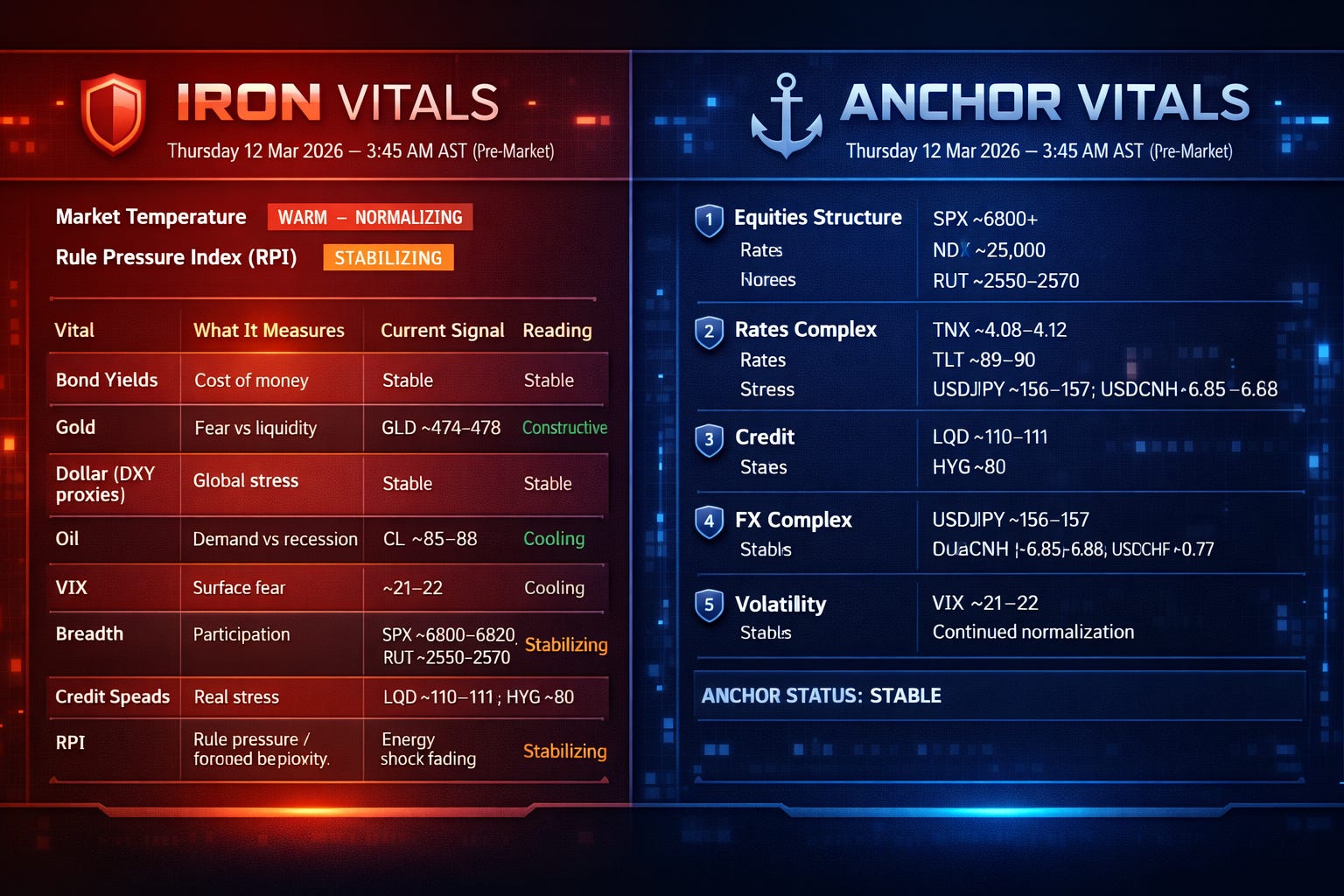
Executive Summary:
Markets continue stabilizing after last week’s energy shock. Crude is holding in the mid-to-high $80s, volatility has eased toward the low-20s, and equities are trading near the 6800 zone. Rates remain steady around 4.08–4.12%, while credit markets remain calm. Conditions point to normalization rather than renewed stress.
Reader Takeaway:
The market is cooling from the energy shock and shifting into a stabilization phase where capital rotates instead of exiting the system.
What Matters:
Oil holding below $90 removes the immediate inflation impulse that drove the volatility spike earlier in the week. VIX continuing to compress toward the low-20s indicates the forced-deleveraging phase has largely cleared. Credit instruments such as LQD and HYG remain steady, confirming funding markets are functioning normally. Large caps remain stable while small caps and cyclicals begin to stabilize alongside them.
Regime Call:
Markets are transitioning from shock repricing toward post-shock stabilization.
Trigger:
A renewed crude surge back toward $100+, combined with volatility expansion above ~30 or widening credit spreads, would signal another pressure wave.
IRON VITALS — Thursday 12 Mar 2026 — 3:45 AM AST (Pre-Market)
Market Temperature:
WARM — NORMALIZING
Rule Pressure Index (RPI):
STABILIZING
Vital
What It Measures
Current Signal
Reading
Bond Yields
Cost of money
TNX ~4.08–4.12
Stable
Gold
Fear vs liquidity
GLD ~474–478
Constructive
Dollar (DXY proxies)
Global stress
USDJPY ~156–157; USDCNH ~6.85–6.88
Stable
Oil
Demand vs recession
CL ~85–88
Cooling
VIX
Surface fear
~21–22
Cooling
Breadth
Participation
SPX ~6800–6820; RUT ~2550–2570
Stabilizing
Credit Spreads
Real stress
LQD ~110–111; HYG ~80
Stable
RPI
Rule pressure / forced behavior proximity
Energy shock fading
Stabilizing
What This Means
The system continues to cool after last week’s energy shock.
Crude has settled in the mid-80s, removing the immediate inflation impulse that drove volatility earlier in the week.
Volatility continues to normalize into the low-20s, signaling that forced deleveraging pressure has largely cleared.
Equities remain stable with large-cap leadership and improving participation from cyclicals and small caps.
Credit markets remain calm and orderly, confirming the system never transitioned into a liquidity event.
Markets are now in a post-shock digestion phase, where capital rotates rather than exits.
If you prefer clarity over reaction, subscribe. Daily regime notes.
ANCHOR VITALS
Thursday 12 Mar 2026 — 3:45 AM AST (Pre-Market)
1️⃣ Equities Structure
• SPX ~6800+
• NDX ~25,000
• RUT ~2550–2570
Read: Structure stabilizing after volatility spike.
2️⃣ Rates Complex
• TNX ~4.08–4.12
• TLT ~89–90
• SHY ~82–83
Read: Rates orderly; no funding stress.
3️⃣ Credit
• LQD ~110–111
• HYG ~80
Read: Credit spreads contained.
4️⃣ FX Complex
• USDJPY ~156–157
• USDCNH ~6.85–6.88
• USDCHF ~0.77
Read: Dollar stable; global flows orderly.
5️⃣ Volatility
• VIX ~21–22
Read: Continued normalization.
ANCHOR STATUS
STABLE
Structural Read
Markets have transitioned from shock response to stabilization.
Three signals define the current regime:
• Oil holding below the crisis threshold
• Volatility returning toward normal levels
• Credit markets remaining calm
When those three conditions hold simultaneously, markets typically shift from panic behavior to rotation and consolidation.
The key variable remains energy — a renewed spike would quickly raise the Rule Pressure Index, while continued stabilization keeps the system in a normalizing regime.
The key variable remains energy.
Earlier stabilization was driven by crude cooling back into the $80s, but the renewed spike shows how sensitive markets remain to potential supply disruptions around Hormuz.
If oil pushes toward $100 alongside rising volatility or widening credit spreads, the shock could propagate again. Otherwise this likely remains a rotation-driven digestion phase rather than systemic stress.