

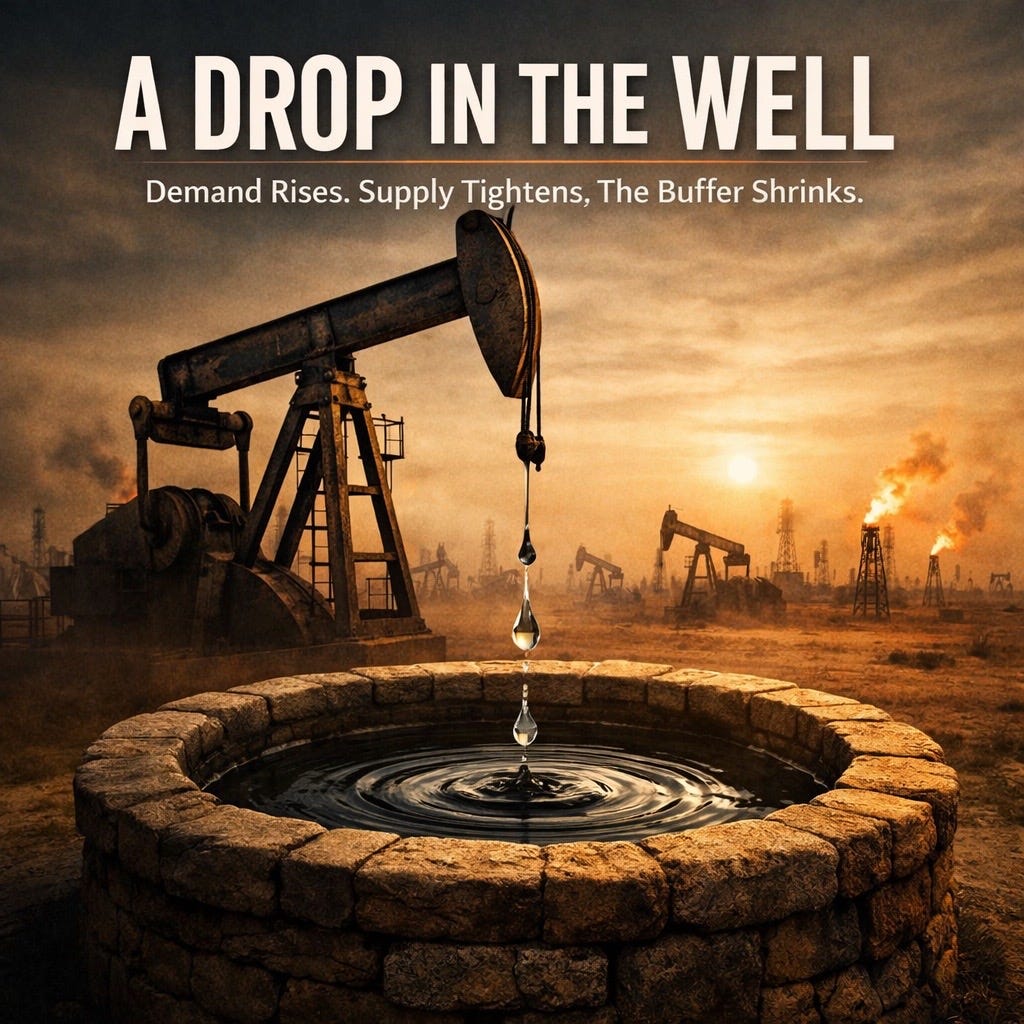
This weekend’s OPEC+ meeting was framed as a supply solution.
It wasn’t.
It was a calibration.
On paper, there’s no visible crude shortage. Inventories aren’t collapsing. Spare capacity exists. Headlines don’t scream crisis.
But energy markets don’t move on paper.
They move on flow.
And global energy usage is rising quietly across multiple fronts:
AI and hyperscale data centers
Cloud expansion
Industrial reshoring
Middle East summer cooling demand
Ramadan consumption surge
Aviation and pilgrimage flows
Saudi Arabia alone is projected to consume more energy over the next three months than it did over the previous six. Domestic burn reduces export capacity. Cooling demand rises. Transport spikes.
Every incremental barrel produced is absorbed faster than expected.
That’s the part surface analysis misses.
The Illusion of Relief
Venezuela’s return sounds meaningful. It isn’t — at least not yet.
Sustainable incremental capacity is likely closer to ~400,000 barrels per day, constrained by:
Infrastructure decay
Upgrader bottlenecks
Diluent dependence
Pipeline reliability
Field decline rates
Capital limitations
Sanction risk
Much of reported output is already domestically tied or operationally restricted.
That’s not a release valve.
That’s a slow rebuild story.
Long-term constructive. Short-term marginal.
Russia and Iran technically produce, but sanction friction keeps these barrels trading through discount channels and workaround systems. Capacity that cannot move freely isn’t true spare capacity.
What OPEC Actually Did
OPEC didn’t flood the market.
They nudged it.
Relative to rising demand and domestic Middle East burn, the increase functions as stabilization — not structural shift.
A drop in the well.
Enough to steady perception.
Not enough to redefine the cycle.
The Structural Question
The issue isn’t whether we are in deficit today.
It’s whether current price levels incentivize enough supply elasticity to cap the cycle.
Structural bull markets persist when:
Capex remains cautious
Political risk suppresses investment
Infrastructure lags demand
Marginal barrels require sustained higher pricing
Energy isn’t constrained by ambition.
It’s constrained by atoms, pipelines, and capital discipline.
Those don’t move quickly.
The Bigger Picture
AI doesn’t run on narratives.
It runs on electricity.
Electricity runs on fuel.
Fuel runs on logistics.
Logistics run on capital.
This is plumbing — not ideology.
So the real question isn’t whether there is “enough oil.”
It’s whether the system can expand fast enough to stay ahead of baseline demand.
Right now, expansion looks:
Incremental.
Cautious.
Structurally tight.
Which is why this meeting changes tone — not trajectory.
It stabilizes sentiment.
It does not break the framework.
And in a market built on marginal supply, sometimes that’s all it takes to keep the well from overflowing.
Or running dry.